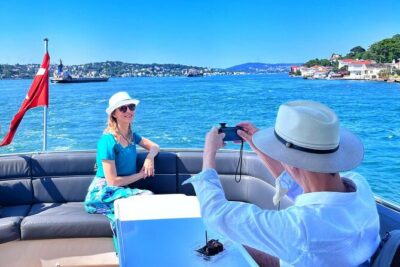
Istanbul changes fast after dark, and the Bosphorus is where that magic feels real. I like that this cruise is simple but scenic: you glide past waterfront Ottoman palaces and major bridge landmarks with Istanbul’s skyline doing the work for you. The second thing I really like is the friendly crew vibe onboard, with standout service like Aleyna and Suleiman making the trip feel smooth and welcoming.
The one thing to think about is timing and weather. It runs about 2 hours, so you’ll want a clear evening for the best views, and the experience does require good conditions to operate.
In This Review
- What you’ll actually see on this Bosphorus cruise
- Key highlights you’ll care about
- Why the Bosphorus at night is such an easy win
- The 2-hour luxury yacht flow, from Beyoğlu and back
- Dolmabahçe Palace along the waterline
- Çırağan Palace: marble, exile, and a hotel glow today
- Ortaköy after dark: cafés, lights, and the Bosphorus bridge glow
- Bosphorus Bridge and the feeling of constant connection
- Bebek: a calmer shoreline stretch with nice dinner energy nearby
- Rumeli Hisarı: fortress walls and fast history at the water’s tightest point
- Fatih Sultan Mehmet Bridge: another modern skyline line crossing your view
- Anadolu Hisarı: the fortress on the Asian side, where the strait tightens
- Kucuksu Palace and Beylerbeyi Palace: Ottoman seaside style under the bridge
- Maiden’s Tower: legend first, silhouette always
- Galataport as a modern finish in Karaköy
- Onboard experience: the crew is part of the value
- Price and value: what $60.47 buys you
- Who this Bosphorus night cruise is best for
- Should you book this Bosphorus Night Cruise?
- FAQ
- What is the duration of the Bosphorus Night Cruise?
- Where does the tour start and end?
- How much does it cost per person?
- Will I get a ticket for this experience?
- How big is the group?
- Does the cruise run in all weather?
- What is the cancellation window?
What you’ll actually see on this Bosphorus cruise
This isn’t a museum day. You’re here for night views: the strait that separates Europe and Asia, plus the palaces and fortress settings that make Istanbul look dramatic even from a distance. With a small max group size (up to 25) and a relaxed pace, it’s a good way to get oriented quickly—especially if it’s your first or second day in town.
That said, expect mostly from-the-water sightseeing, not entering palaces or fortresses. If you’re hoping for lots of walkable stops on land, you might find this format a bit more pass-and-photograph than explore.
Key highlights you’ll care about
- Sunset and night skyline views along the Bosphorus, with major landmarks lit up
- Waterfront Ottoman sights like Dolmabahçe and Çırağan seen from the strait
- Bridge photo stops without the hassle of traffic or waiting on viewpoints
- A compact 2-hour format that fits easily between dinner and a night stroll
- Small-group feel with a maximum of 25 travelers
- Onboard hospitality that keeps the mood relaxed and fun
Why the Bosphorus at night is such an easy win
The Bosphorus (also called the Bosporus) is the narrow, international waterway that literally splits Istanbul into two worlds: the European side and the Anatolian side. At night, that geography becomes visual. From the yacht you can often tell where one side ends and the other begins just by following the lights and shoreline curves.
You also get an extra layer of interest because the Bosphorus isn’t just scenic; it’s an active water route. The currents run from the Black Sea toward the Sea of Marmara on the surface, and the direction flips underwater. That’s not something you’ll measure with a stopwatch on a cruise, but it helps explain why the strait feels alive even when you’re only taking it in slowly.
If you like Istanbul for its contrast—old empires, big bridges, modern ports—night is when the contrast reads best. Everything turns into silhouettes and reflections, and you don’t have to work too hard to get great photos.
The 2-hour luxury yacht flow, from Beyoğlu and back
Your tour starts and ends at Ömer Avni, İskele Yolu No:30, 34427 Beyoğlu/İstanbul. It’s built around an easy loop: you head out onto the water, see a sequence of landmark areas, then finish back at the starting point.
The duration is about 2 hours. That short window is actually a benefit in Istanbul, where logistics and timing can drain your energy. You’re not committing to a full half-day tour, so you can still eat well afterward and still have time for a nighttime walk.
Two practical points that matter. First, the group is kept small (maximum 25), so you’re not stuck in a huge crowd. Second, you’ll have a mobile ticket, which cuts down on fiddling with printouts—one less thing to manage before dark.
Also note the timing in the real world: on average, this kind of cruise is booked about 33 days in advance. If you’re traveling in peak season or on a busy weekend, booking earlier helps you lock in the slot you want.
Dolmabahçe Palace along the waterline
Dolmabahçe Palace sits on a huge waterfront estate in Beşiktaş, along the stretch leading into the Bosphorus from the Sea of Marmara. One reason this stop is so worthwhile from a night yacht is that palaces like this look different at sea level than they do from land.
From the water, you’re seeing the palace relationship to the Bosphorus itself—the way sultans and elites used the strait as a front door. You also get a strong sense of the palace’s position opposite the Asian side areas, which helps you mentally map Istanbul’s two halves.
Practical consideration: you’ll likely get the best payoff by staying on the deck and letting your eyes do the work. Night views can be less clear than daytime ones, so give yourself a few minutes to adjust and enjoy the reflections rather than rushing for one quick shot.
Çırağan Palace: marble, exile, and a hotel glow today
Çırağan Palace was commissioned by Sultan Abdulaziz and designed by architect Sarkis Balyan. It’s also tied to a tougher story: after Abdulaziz was deposed, he was imprisoned here with his family; later, Murat V was also imprisoned there for decades. In other words, this wasn’t only about glamour—it was about power in a very serious way.
From the yacht, the key value is how you connect architecture to location. The palace is made of marble and covers about 80,000 square meters, but your view comes back to the setting: it’s on the Bosphorus shore, where the water would have made arrivals and departures feel ceremonial.
Then the story changes again in modern times. After damage and later restoration, the grounds reopened as a luxury hotel. You don’t need to tour inside to feel the contrast between imperial residence history and today’s hospitality.
If you’re someone who likes human-scale context, Çırağan gives it. It’s not just scenery; it’s a reminder that these waterfront “view-makers” were also political places.
Ortaköy after dark: cafés, lights, and the Bosphorus bridge glow
Ortaköy is on the European side in Beşiktaş, right along the Bosphorus. The neighborhood has its own pace, with Ortaköy Bazaar and lots of cafés, bars, and souvenir shopping mixed in. The bazaar is lively throughout the day, though early morning can feel a bit less active.
For a night cruise, that background helps you understand what you’re passing. You’re not seeing Ortaköy as a daytime shopping street; you’re seeing it as a lively shoreline neighborhood that continues after dark. Even from the water, the energy reads through in the lights and the way people move near the water.
You’ll also be close to some of the Bosphorus Bridge area views, which makes Ortaköy a strong visual setup. If you’re the type who loves “one perfect photo” moments, this stretch is designed for that.
Bosphorus Bridge and the feeling of constant connection
The Bosphorus Bridge connects the European and Anatolian sides and is located at Ortaköy (European side) and Beylerbeyi (Anatolian side). It was the first bridge built over the Bosphorus, with construction starting in 1970 and opening in 1973.
Why does this matter on a night cruise? Because you can see the bridge as a symbol of Istanbul’s nonstop linking of continents. On water, the bridge can feel even more dramatic since you’re literally beneath the “connection” instead of standing across it.
Also, the bridge has a history detail that makes it more than just infrastructure. It was opened on 29 October 1973, marking the 50th anniversary of the proclamation of the Republic. You’ll likely notice the bridge’s role immediately just by how busy it feels at all hours.
Your best move: don’t chase only one angle. Give yourself a couple passes. Night photos can look better once you find the spot where reflections on the water line up with the bridge.
Bebek: a calmer shoreline stretch with nice dinner energy nearby
Bebek is a historic neighborhood on the European side of the Bosphorus. The word Bebek means baby, which points to how popular and attractive the waterfront location became during the Ottoman period.
From the cruise perspective, Bebek is a breather. Along this stretch, you’re seeing a mix of waterside mansions and notable landmarks like Bogazici University in the general area, plus the feel of a residential shoreline that’s not only about monuments.
The practical upside is that Bebek works well in the middle of your tour when you want scenic cruising without constant “big landmark now” pressure. You still get the Bosphorus view, but it feels a little more relaxed.
If your Istanbul plan includes one of those Bosphorus-view dinners afterward, this is a good stretch to remember. You’re passing the kind of neighborhood that makes those plans seem effortless.
Rumeli Hisarı: fortress walls and fast history at the water’s tightest point
Rumeli Hisarı (Rumeli Fortress) sits in Sariyer on the European side, built directly across from Anadolu Hisarı. Construction started in 1453 at Sultan Mehmet the Conqueror’s order, placed at the narrowest point of the strait. The fortress was completed in a surprisingly short span of three months.
The story is useful because it explains what you’re seeing. Before the conquest of Istanbul, it protected against naval attacks; after the conquest, it served as an inspection point for maritime traffic. That means the fortress is tied to controlling movement on the Bosphorus, not only watching it.
On a night cruise, fortress stone and cliff-like edges often show best as silhouettes. Even if details are harder in the dark, the shape of the location still tells you the purpose.
There’s also a modern cultural angle here. After restoration work in 1953 removed the small wooden houses, the fortress became known for summer concerts and today functions as an open-air theater and museum. From the water at night, you’re basically catching it in the role it plays now: a dramatic backdrop for events.
Fatih Sultan Mehmet Bridge: another modern skyline line crossing your view
The Fatih Sultan Mehmet Bridge is the second major bridge over the Bosphorus, built between Kavacık and Hisarüstü. Construction began in 1986 and it opened on 3 July 1988, with the bridge noted as the 14th largest steel suspension bridge in the world.
What makes it rewarding on the cruise is the scale. Night is when large structures feel even bigger and cleaner, especially when lights outline the bridge’s lines against the dark strait.
You’ll also feel the practical reason for its existence: together with the first Bosphorus Bridge and ferries, it carries a significant portion of trans-Bosphorus traffic. The bridge isn’t just a landmark; it’s a working piece of the city’s heartbeat.
If you like urban design, this is one of the clearest “Istanbul is modern too” moments on the itinerary.
Anadolu Hisarı: the fortress on the Asian side, where the strait tightens
Anadolu Hisarı is on the Asian side in Beykoz, at the narrowest point of the Bosphorus, and it was built in 1395 by Beyazit I. It consists of a citadel and exterior castle walls.
This fortress has a longer timeline in the land-use sense. After the conquest of Istanbul, it lost strategic importance and was converted into a military hospital. Later restoration work (1991–1993) turned it into a museum, though it’s not open to the public; you can visit only the outer walls, and the road passes just through it.
From your yacht, you’ll likely get what matters most: the setting and the presence. At night, the fortress reads as a dark mass with the shoreline framing it. It’s one of the places where the cruise view helps you understand why this part of the strait mattered so much to earlier rulers.
Kucuksu Palace and Beylerbeyi Palace: Ottoman seaside style under the bridge
Küçüksu Palace (Küçüksu) is a small Ottoman summer palace ordered by Sultan Abdulmecit and designed by Nikogos Balyan. It’s located on the Bosphorus coast road between Uskudar and Beykoz, known for its Bosphorus view and the way sultans used it for relaxation.
Then you move toward Beylerbeyi Palace, built in the 1860s on the shores of the Bosphorus. It sits right under the Bosphorus Bridge, designed again by Sarkis Balyan, and it mixes architectural elements including Renaissance and Baroque influences.
Beylerbeyi is especially interesting because of its details. It has six halls, 24 rooms, and includes a hamam. And it’s not only about the building. The palace gardens include a lily pond, which is the kind of detail that usually looks lovely in any season.
On a night cruise, you probably won’t see every room or garden feature clearly. But you will see the relationship: palace grounds pressed against the strait, with bridges and water shaping how everything looks from one side to the other.
Maiden’s Tower: legend first, silhouette always
Kız Kulesi (Maiden’s Tower) is one of the most recognizable shapes on the Bosphorus skyline. It sits on a tiny island about 200 meters from the shore of Üsküdar, and it’s the focus of multiple legends.
The best-known story is the one you’ll hear in the general legend tradition: an oracle predicts a sultan’s daughter will be killed by a snake bite on her 18th birthday. The sultan tries to protect her by building the tower in the middle of the Bosphorus. On her birthday, a hidden snake in a fruit basket bites her, and she dies in her father’s arms.
Even if you’re not a legend person, the tower works on the senses. At night, the tower’s shape and distance from the shore make it feel like a real-time story setting.
This is a stop where I’d slow down. Don’t just grab a photo. Let your eyes track from the shoreline to the tower so you understand scale and location.
Galataport as a modern finish in Karaköy
Galataport is a modern port and social hub in the Karaköy area. The space blends the historical feel of Istanbul with contemporary architecture, and it includes restaurants, cafés, shops, and cultural venues.
From the perspective of your cruise ending, Galataport matters because it’s a clean transition. You go from classic Ottoman and fortress imagery to a more current Istanbul setting that still feels connected to the waterfront. There’s also an underground terminal designed to manage cruise ship traffic, which hints at how major the port has become.
If you want a smooth next step after the cruise, Galataport is a logical place to head. You’ve just been staring at waterfronts for two hours, so naturally you’ll want somewhere lively to linger on land.
Onboard experience: the crew is part of the value
This cruise’s top strength is human. A friendly crew makes a big difference when the itinerary is mostly visual. When people are relaxed and organized, you spend less time figuring things out and more time enjoying the views.
The names Aleyna and Suleiman show up in the kind of comments that matter: guests talk about the welcome and the way the crew helps the moment feel special. That lines up with the format too. With a small group (up to 25), service quality can actually shine.
If you’re worried about learning much on your own, don’t be. You can keep it simple: let the crew guide your attention to key viewpoints, and use the night atmosphere to do the rest.
Price and value: what $60.47 buys you
At $60.47 per person for about 2 hours, you’re paying for three things: time on the water, a comfortable luxury yacht setting, and a high-density set of landmark views along one route.
You’re not paying for a long museum visit with many tickets and rules. You’re buying a compact experience that’s ideal when you want skyline payoff without spending half a day in transit.
It also tends to be good value for groups who want low effort. If your travel style includes scenic breaks between heavier sightseeing, this cruise fits nicely. And because the booking pace is often about a month out on average, planning ahead increases your odds of a good slot.
One more value note: the requirement of good weather matters. If you’re traveling around a rainy stretch, consider booking with flexibility so you’re not stuck disappointed. The good news is that the experience is set up for a weather-dependent night outcome, not a guaranteed indoor substitute.
Who this Bosphorus night cruise is best for
I’d book this if you:
- Want a first-time Istanbul orientation with big-name waterfront landmarks
- Like views that move (instead of standing in one place)
- Prefer a small-group pace with up to 25 people
- Are chasing sunset and night lighting more than deep museum time
- Want a relaxing break that still feels exciting
I might skip it if you want long land walks, museum entry, or a full half-day of in-depth cultural touring. This is a cruise format, so your main payoff is what you see from the water and how the night atmosphere feels while you do it.
Should you book this Bosphorus Night Cruise?
Yes, if your ideal Istanbul evening includes a short, easy plan and strong nighttime views. The combination of Bosphorus scenery, landmark variety (palaces, bridges, fortress setting, Maiden’s Tower), and a crew that makes the trip feel genuinely friendly makes it an easy recommendation for people who want value without stress.
If you’re deciding between multiple night activities, this one has a clear advantage: it uses the strait itself as the attraction. You don’t have to hunt for viewpoints, and you don’t have to rearrange your schedule around traffic.
If the weather forecast looks iffy, keep an eye on conditions, because night on the water is the whole point.
FAQ
What is the duration of the Bosphorus Night Cruise?
The cruise lasts approximately 2 hours.
Where does the tour start and end?
It starts at Ömer Avni, İskele Yolu No:30, 34427 Beyoğlu/İstanbul, Türkiye, and it ends back at the same meeting point.
How much does it cost per person?
The price is $60.47 per person.
Will I get a ticket for this experience?
Yes. You’ll have a mobile ticket.
How big is the group?
The experience has a maximum of 25 travelers.
Does the cruise run in all weather?
It requires good weather. If it’s canceled due to poor weather, you’ll be offered a different date or a full refund.
What is the cancellation window?
You can cancel up to 24 hours in advance for a full refund. If you cancel less than 24 hours before the start time, the amount you paid is not refunded.