REVIEW · GOREME
Southeast Anatolia Tour (Nemrut, Gobeklitepe, Zeugma)
Book on Viator →Operated by Hereke Travel · Bookable on Viator
Three big ancient stops in one trip.
This Southeast Anatolia tour is built around sites you usually only hear about in textbooks: Göbeklitepe, Mount Nemrut, and Zeugma’s mosaics. One day you’re looking at monumental stone work from 9,600–8,200 BCE. The next, you’re on a high peak watching the day start over giant statues tied to King Antiochos I of Commagene. It’s history that feels physical, not distant.
What I really like is the way the trip balances the awe-factor with practical pacing: Göbeklitepe is given enough time for you to actually absorb what you’re seeing, and the Zeugma Mosaic Museum lets you understand daily life through full-scale replicas rather than only fragments behind glass. One possible drawback: you’re signing up for a lot of early, outdoors time, and this tour needs good weather. If you’re sensitive to cold or long travel days, plan accordingly.
In This Review
- Key Highlights You Should Know
- The Big Idea: Why These Three Sites Work Together
- Karatay Han: A Quick Stop on a Medieval Trade Road
- Mount Nemrut at Dawn: The Antiochos I Giant-Statue Moment
- Göbeklitepe: Monumental Stone from Before Cities
- Zeugma Mosaic Museum: Ancient Streets, Rebuilt at Full Scale
- What the Days Feel Like: Pace, Meals, and Early Starts
- Price and Value: Is $984.82 Worth It?
- Who Should Book This Tour (and Who Should Rethink)
- Should You Book the Southeast Anatolia Tour?
- FAQ
- Where does this tour start?
- How long is the tour?
- What is included in the price?
- Are admissions included?
- Is pickup included?
- Is this a private tour?
- How will I get my tickets?
- What if the weather is bad?
- What is the cancellation policy?
Key Highlights You Should Know
- Göbeklitepe’s megaliths date to the Pre-Pottery Neolithic period, built long before cities.
- Mount Nemrut’s dawn viewpoint connects the place to Antiochos I and dramatic giant statuary.
- Zeugma Museum replicas recreate streets, fountains, building walls, and foundations in scale.
- A trade-road context stop at Karatay Han helps you understand how people moved through this region.
- Private group format means your group stays together without mixing with strangers.
The Big Idea: Why These Three Sites Work Together
This itinerary makes a clever arc across time. You start with human movement and commerce on an old road. Then you jump to some of the earliest monumental construction on Earth. Finally, you land in the Roman-era world of Zeugma, where art and daily settings survive through mosaics and reconstructions.
That mix matters because it stops the trip from feeling like three unrelated museum visits. Instead, you see how a region can change its “main story” over millennia: from travel routes and traders, to ritual sites built by hunter-gatherers, to an urban culture remembered through art.
And you’re not just touring landmarks. You’re also dealing with real rhythms: early starts, time outdoors, and time indoors. Since the tour includes accommodation and meals (breakfast, lunch, dinner), it helps you spend your energy on sights instead of constant logistics.
You can also read our reviews of more tours and experiences in Goreme.


Karatay Han: A Quick Stop on a Medieval Trade Road
Day one includes Karatay Han, a caravanserai built on the old Kayseri–Malatya road, a major route feeding trade into Syria. This is not the kind of stop where you stand and stare at one single monument for hours. It’s more useful than that.
The point of Karatay Han is context. In the 13th century, it sat at a junction where roads led from Syria, Iraq, eastern Anatolia, and Iran toward Kayseri and Sivas. Where there was traffic, there were services: food, lodging, small commerce, and the kind of busy side streets that grew around major routes. Today it’s a quieter rural village, so the han becomes a time machine for imagining what used to happen here.
You get about 25 minutes at this stop, with an admission ticket included. That duration is ideal if you like history but don’t want a full half-day detour. It’s also a good warm-up for the rest of the trip, because after Nemrut and Göbeklitepe, you’ll be in full absorption mode and you’ll want your brain already switched on.
Practical tip: keep this stop in the “look and learn” category. If you try to make it your main emotional highlight, you may feel underwhelmed. If you treat it as setup, it lands well.
Mount Nemrut at Dawn: The Antiochos I Giant-Statue Moment
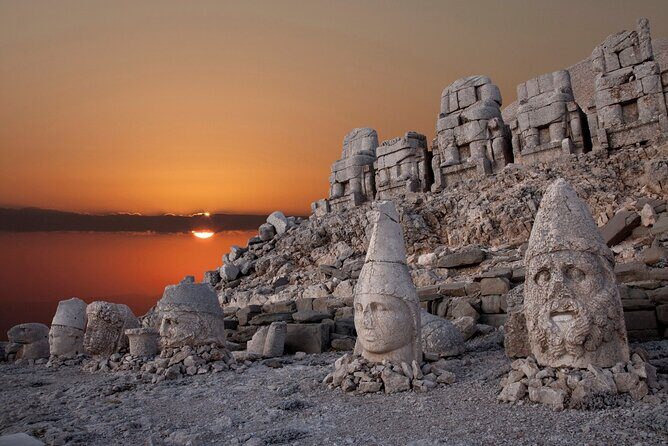
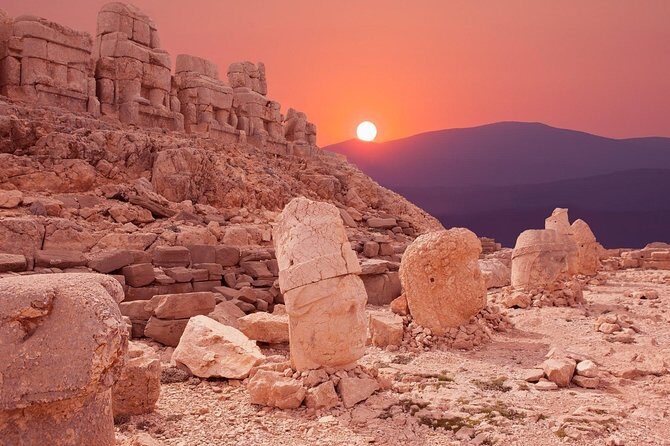
Then comes Mount Nemrut, and this is where the tour’s dramatic promise becomes real. Nemrut Dağ crowns one of the highest peaks in the Eastern Taurus range in south-east Turkey, and the site is the Hierothesion built by King Antiochos I of Commagene (69–34 B.C.). This wasn’t a simple tomb. It was a monument built as a house of the gods and a statement by Antiochos himself.
The reason Nemrut is famous isn’t just age. It’s scale and atmosphere. The overview theme is watching the dawn with Antiochos and the other giant statues, and that’s exactly why this stop is so tightly linked to time of day. Sunrise views turn these stones into silhouettes, and they feel otherworldly because the site is high, exposed, and weather-dependent.
The included admission and the dedicated visit time (listed at 1 hour) are meant to give you the essential look without letting the day drag. Still, plan for the fact that Nemrut is outdoors and you’re dealing with the kind of conditions where wind can steal your attention. If you go expecting a relaxed stroll, you may be caught off guard.
Who will love this most: people who like spectacle but also want meaning tied to a real ruler and a real historical program. The statues aren’t decorative extras here; they’re the point.
One consideration: because the tour “requires good weather,” your Nemrut experience can hinge on conditions. If visibility is poor, the dawn impact may be less than you hoped, even if the visit still happens.
Göbeklitepe: Monumental Stone from Before Cities
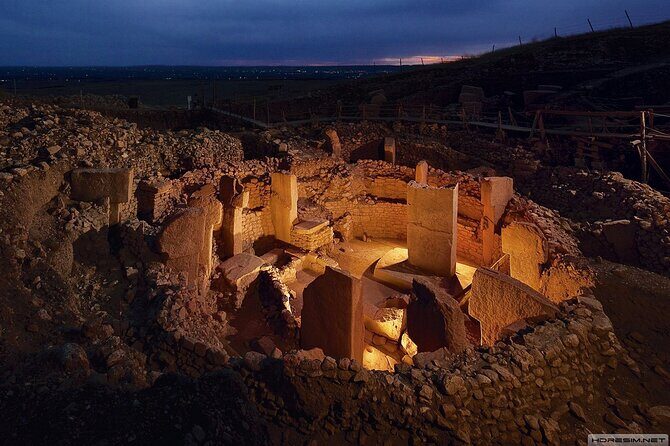
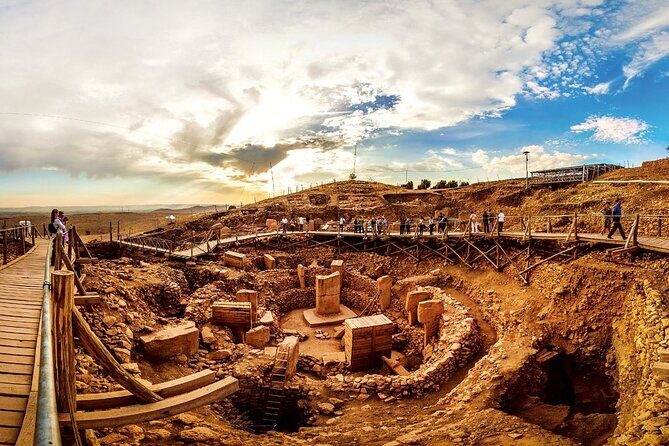
After Nemrut, you’ll shift to Göbeklitepe, located in the Germuş mountains of south-eastern Anatolia. This is the site that stops people mid-sentence because the dates are so extreme: the monumental round-oval and rectangular megalithic structures were erected in the Pre-Pottery Neolithic age between 9,600 and 8,200 BCE by hunter-gatherers.
Think about what that implies. You’re not just touring old ruins. You’re seeing evidence of coordinated building and ritual life long before the dawn of civilization as we commonly define it. That’s why the site is often described as a turning point in human understanding. Even if you know the headlines, being there makes it feel more real—like the stones are still holding onto the intention behind them.
You get about 1 hour here, with admission included. That sounds short until you remember what kind of place it is. Göbeklitepe rewards attention. If you give yourself only a quick glance, you might miss the pattern of how the spaces are shaped and how the megaliths create zones of meaning.
Practical tip: I’d focus on two things. First, look at the way the structures are arranged (round-oval versus rectangular). Second, keep an eye on scale—these are big stones built by people without today’s tools. If you’re traveling with kids, this is one of the few ancient stops where you can turn questions into an instant game: who built it, why so many stones, and how could they have organized it?
Zeugma Mosaic Museum: Ancient Streets, Rebuilt at Full Scale
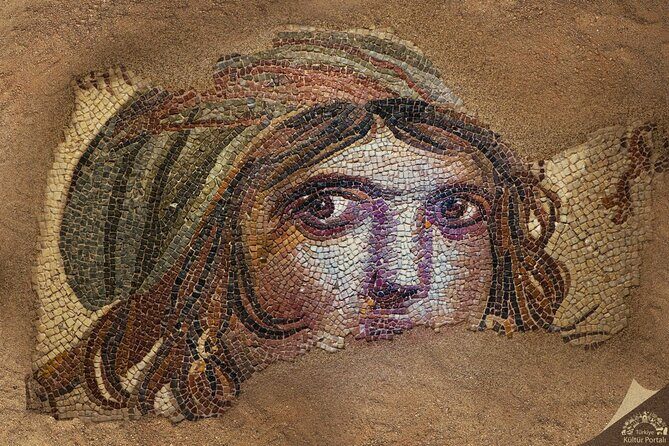
On day three you go to the Zeugma Mosaic Museum. This stop offers a different kind of satisfaction than open-air ruins. Instead of walking among exposed remains, you’re shown a slice of how life may have looked in the city using full-scale replicas.
The museum recreates the environment using life-sized reconstructions of a street, a fountain, building walls, and even foundation stones, built according to the architecture of the time. That approach helps you do something important: connect mosaics and artifacts to the physical layout they once belonged to.
If you’re the type of traveler who gets more from places where you can picture daily life, you’ll likely enjoy Zeugma’s method. You don’t need to be a mosaic specialist to get value here. You just need the imagination to place yourself inside the recreated street setting.
The visit time is listed at 1 hour, with admission included. In practice, that’s a good length for a museum built around reconstructions because you’ll see the main areas without getting museum-burnout.
A consideration: if you love big outdoor views more than indoor exhibits, Zeugma may feel quieter. But if you like art, layout, and how cities worked, it’s a strong finish.




What the Days Feel Like: Pace, Meals, and Early Starts
This is a 3-day tour with accommodation for 2 nights and meals planned: breakfast twice, dinner twice, and lunch three times. For me, that’s a big part of the value. You’re not constantly searching for food after long drives and early mornings. It’s especially helpful on a route like this where the schedule depends on weather and timing.
The tour also lists pickup offered and a format described as private, meaning only your group will participate. Private doesn’t automatically mean slower, but it usually does mean the experience is less chaotic. You’re less likely to feel like you’re being rushed between places while everyone fights for the same photo angle.
Another practical detail: the listed operating hours run from 5:00 AM to 5:00 PM during the date range shown. That matches the reality of Nemrut-at-dawn style sightseeing. So yes, you should expect an early day. If your ideal vacation day starts after 10 AM, this one might push you out of your comfort zone.
Also, you’ll want to dress for outdoor conditions and plan for the fact that the highlight moments are not all inside. Nemrut will ask for real layers, and Göbeklitepe is in open mountain terrain too.
Price and Value: Is $984.82 Worth It?
At $984.82 per person, this tour isn’t a budget pick. But it’s also not just a ticket to three sites. You’re buying the whole package: accommodation, meals, admission included at the stops, and a private-group structure with pickup offered.
Here’s how I’d judge value, practically:
- You’re paying for convenience across distance. Getting from Goreme out to this part of south-east Turkey isn’t something you want to do as a DIY puzzle if you also want Nemrut at the right time.
- Admissions are included at the major stops, including Karatay Han, Mount Nemrut, Göbeklitepe, and Zeugma’s museum.
- Meals are covered, which reduces daily expense and planning stress.
The value is strongest if you’re the kind of traveler who hates spending vacation time coordinating. You hand off the schedule, you get the core experiences, and you can focus on looking and learning.
If you’re the type who enjoys building your own route and loves independent travel logistics, this price may feel steep. But most people who sign up for this kind of ancient-and-sunrise itinerary do it because they want the schedule handled.
One more angle: the tour lists group discounts and mobile ticket. If you can travel with friends or family, you may reduce the per-person cost.
Who Should Book This Tour (and Who Should Rethink)
This works best for travelers who want a compact, high-impact sweep of Southeast Anatolia without sacrificing major time at each site.
It’s especially good for:
- People who love early history and want to stand in front of sites dating back thousands of years.
- Families who can handle an early day. One write-up mentioned success traveling with children and also with adults in their seventies, which is a good sign that the pacing is workable for mixed groups.
- Travelers who enjoy learning with a guide. The trip’s organization and explanation style seem to be a big part of why it lands well.
Who should rethink it:
- Anyone who cannot manage early starts or outdoor conditions.
- People who want a slow, lounging vacation with lots of downtime between stops.
If you can handle long days and want to see some of the most consequential sites in the region, you’ll likely feel like the trip is tightly planned around the highlights rather than just checking boxes.
Should You Book the Southeast Anatolia Tour?
If your dream Turkey trip includes seeing Göbeklitepe, watching the story of Antiochos I unfold at Mount Nemrut, and ending with Zeugma’s reconstructed world, then yes, I’d book it. The structure makes sense: trade-route context, then the earliest monumental culture, then the Roman-era city feel through replica environments.
I’d book especially if you like planning-light travel: pickup, private format, accommodation, and meals already handled. For many people, that turns a complicated region into a smooth three-day arc.
I would hesitate only if you dislike sunrise-style timing or you’re worried about weather. Since the experience requires good conditions, keep flexibility in mind.
If you’re already traveling from Göreme, this is a strong add-on that gives you more than just Cappadocia views and balloons. It adds an entirely different time scale.
FAQ
Where does this tour start?
The tour is listed with the location as Göreme, Turkey.
How long is the tour?
It’s listed as approximately 3 days.
What is included in the price?
The package includes accommodation for 2 nights, breakfast twice, dinner twice, and lunch three times.
Are admissions included?
Admission tickets are marked as included for Karatay Han, Mount Nemrut, Göbeklitepe, and the Zeugma Mosaic Museum.
Is pickup included?
Pickup is offered.
Is this a private tour?
Yes. It’s described as private, with only your group participating.
How will I get my tickets?
The tour includes a mobile ticket.
What if the weather is bad?
The experience requires good weather. If it’s canceled due to poor weather, you’ll be offered a different date or a full refund.
What is the cancellation policy?
Free cancellation is available. You can cancel up to 24 hours in advance for a full refund. Changes made less than 24 hours before the start time aren’t accepted.