REVIEW · PAMUKKALE
Full Day Pamukkale City Tour From Pamukkale And Karahayit Hotels
Book on Viator →Operated by Payless · Bookable on Viator
White terraces hit fast.
This full-day Pamukkale City Tour is a good way to stack the big sights in one day without thinking about transport. You get an air-conditioned ride, an English-speaking guide, and a plan that starts early and moves through Pamukkale’s thermal formations and Hierapolis ruins at a readable pace.
I like two things a lot. First, the Karahayit stop is a real change of scenery: red, iron-rich hot springs where the water can feel scorching and the cliffs take on that rusty color. Second, the guided walk through the ancient cemetery and the Hierapolis area helps you understand what you’re looking at when the ruins start blending together on your own.
One thing to plan for: entrance fees are not included in the tour price. That means you should budget extra for the paid site entries (especially the Hierapolis/Pamukkale area and Cleopatra Pools).
In This Review
- Key Highlights You’ll Feel Right Away
- How This Pamukkale Tour Fits Into a Tight Schedule
- Hotel Pickup and Air-Conditioned Bus Comfort
- Karahayit Red Spring: The Warm-Water Detour Most Days Need
- Entering Hierapolis: Necropolis Details You’ll Actually Use
- Pamukkale Natural Park: White Terraces, Practical Timing, and Crowds
- Cleopatra Pools: Worth It, But Know the Extra Entry Fee
- Lunch and the Workshop Stop: Getting Fed Without Losing the Day
- Guide Impact: When Ismail, Özlem, or Ahmet Makes It Click
- What to Bring (So the Day Feels Easy, Not Miserable)
- Price and Value: Is $45 a Good Deal for Pamukkale?
- Should You Book This Pamukkale Full-Day City Tour?
- FAQ
- What’s included in the Pamukkale City Tour price?
- How long is the tour?
- What time does the tour start?
- Where do I meet the tour if my hotel has privacy rules?
- What’s the main meeting point listed for this tour?
- Is the ticket for Hierapolis and Pamukkale included?
- Is Cleopatra Pools included in the price?
- Is lunch included, and what type is it?
- Is there a limit on group size?
- What’s the cancellation policy?
Key Highlights You’ll Feel Right Away
- Karahayit red spring hot pool time with iron-rich water and red cliffs
- Guided walk through Hierapolis ruins and the necropolis area
- Time on the white travertine terraces plus the Natural Park viewpoints
- Cleopatra Pools photo-and-swim window with extra entry cost
- Open buffet lunch at a local restaurant
- Small group size (max 16) for a less-chaotic day
How This Pamukkale Tour Fits Into a Tight Schedule
If your time in Denizli/Pamukkale is limited, this tour does a smart job of bundling the main highlights. A lot of people come to Pamukkale and only see the famous white terraces. This day also aims to put the Roman city story in your head while you’re still standing in the right place to understand it.
The schedule is built around movement. You’ll start in the morning, you’ll have multiple stops across Pamukkale and nearby Karahayit, and you’ll finish back at your pick-up area in the afternoon. In practical terms, that means you trade “slow travel” for “see a lot, learn a lot, eat well enough, move on.”
And yes, it’s a busy day. But if you’re the type who wants your photos, your ruins, and your thermal water in one package, this format usually works.
You can also read our reviews of more tours and experiences in Pamukkale.


Hotel Pickup and Air-Conditioned Bus Comfort
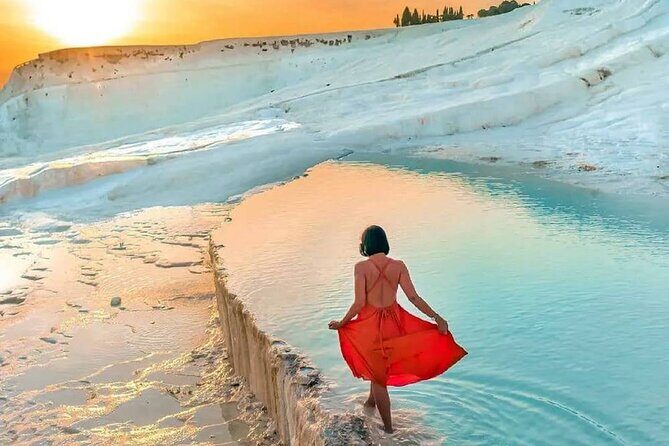
This tour includes hotel pickup and drop-off, and the ride is on a fully air-conditioned bus. That matters here because Pamukkale mornings can start cool and then heat up fast once you’re walking around exposed areas.
There’s also a small but important detail about where to meet: because many hotels have high privacy rules, you should meet the group at the main entrance gate, not the reception desk. That’s the difference between a smooth start and a lot of waiting in the sun.
The tour has a maximum of 16 travelers, which keeps things from feeling like a cattle-car day. Still, expect that “guided group logistics” can be a little rigid. If you hate tight timing, you’ll feel it more here than on a fully independent day.
Karahayit Red Spring: The Warm-Water Detour Most Days Need
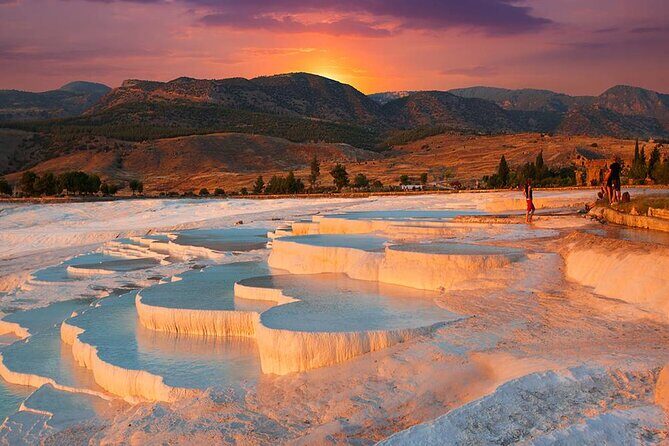
Before you get deep into Pamukkale, you’ll head to Karahayit for another thermal pool experience. The star here is the red spring—named for the iron content in the water. The cliffs can look red because of the mineral makeup, which gives you a different visual style than the bright white terraces.
You’ll have time to take off your sandals and get into the warm water. Do not treat this like a casual splash. The water is described as burning hot, so plan on moving slowly, staying aware of your footing, and treating it like a therapeutic soak rather than a fun water park.
Also, go in with bare-water realism. Pamukkale waters and rocky surfaces are not usually forgiving on feet. If you’re sensitive, you might want to take extra care with how you step around the edges before you fully submerge.
This stop is only about half an hour, so it’s not meant to be a long hangout. It’s more like a palate cleanser and a quick reminder that this region is built on geothermal energy.
Entering Hierapolis: Necropolis Details You’ll Actually Use
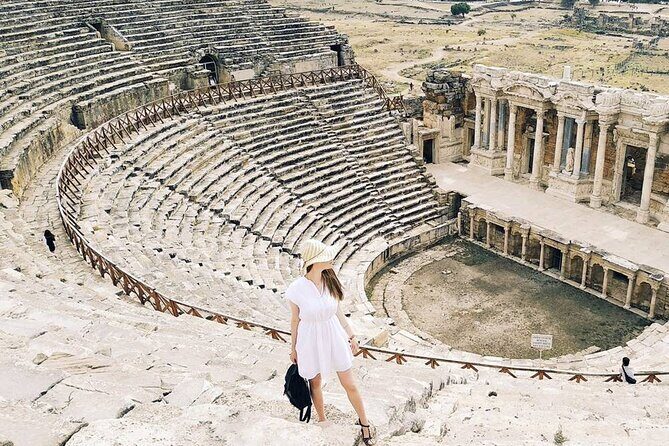
After Karahayit, you’ll move into Pamukkale and enter the area via the south gate. This is where the tour shifts from “thermal sights” to “why the Romans built here.”
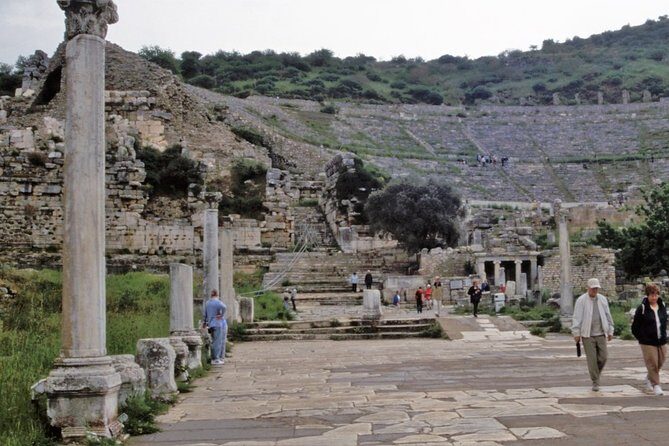
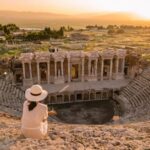
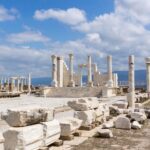
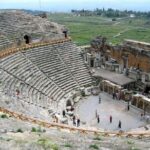
You’ll walk through the remains of an ancient cemetery and then into the broader Hierapolis ruins. The tour includes an experienced, licensed professional guide who gives you the context as you go—exactly what helps the place click. Ruins can look like scattered stones if you don’t have a story to attach to them. With a guide, you can connect what you see to what it used to mean.
Here’s the balancing act. The time for the Hierapolis section is around one hour, so you won’t have hours to wander like a scholar. But you will get a guided highlights version—enough to understand the scale and feel the layout without spending your whole day chasing details.
Just be aware of the ticket reality: entrance fees are not included for these historic site portions. That’s not always obvious until you’re at the gate, so carry extra money and keep your ticket timing calm.
Pamukkale Natural Park: White Terraces, Practical Timing, and Crowds
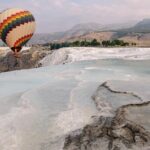
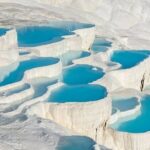
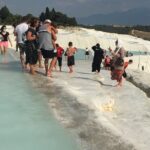
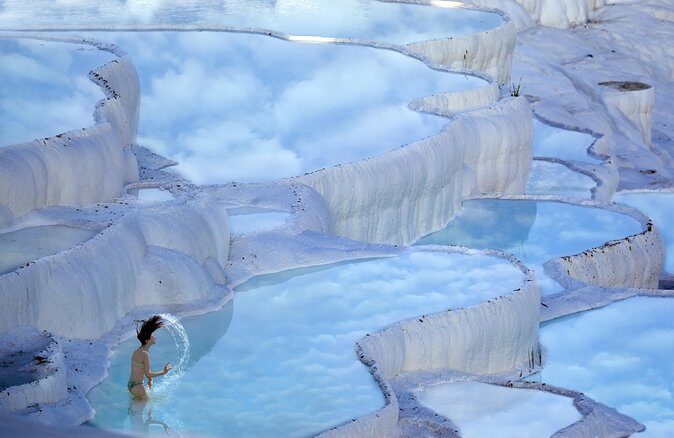
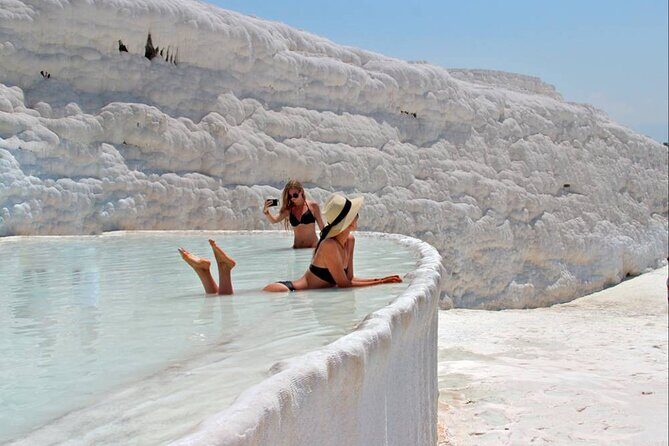
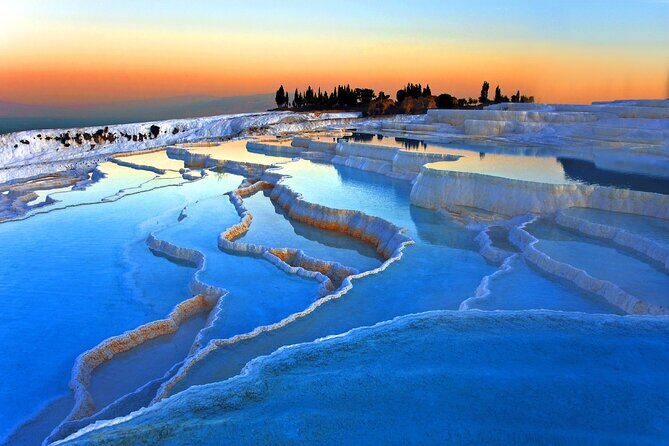
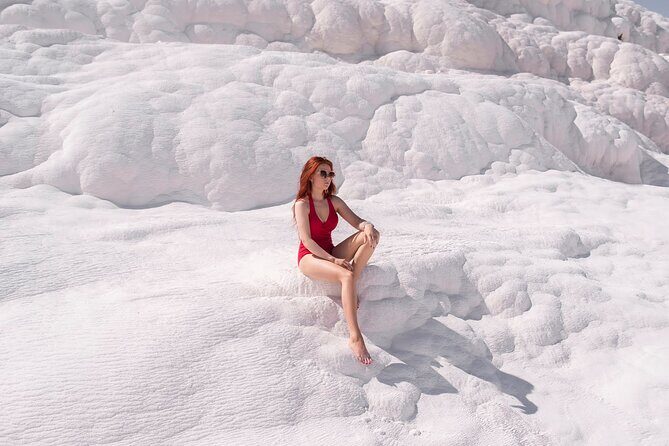
Next comes the part most people picture when they think of Pamukkale: walking the white cliffs and travertine-like terraces in the Natural Park area. You’ll have around two hours here, which gives you room to do three things:
- walk out along the formations,
- pause for photos,
- and if conditions and access allow, swim or cool off in the water pools over the terraces.
This is the area where crowds can matter. On busy days, the white terraces can feel tightly packed, especially at the most photographed angles. The good news is that the park is big enough that you can find breathing space if you’re willing to walk a bit.
If you come when water levels are lower, you might notice the formations look different than the glossy postcard versions. In some months, the water can be lower, which changes what you can do in the pools. The terraces stay stunning, but the “wow factor” may be more about shape and light than a full-on swim.
Also: footwear matters. You’ll likely spend time stepping on surfaces connected to the thermal areas, and bare feet can be painful when you hit small rocks. Your best friend is patience plus careful steps, not speed.




Cleopatra Pools: Worth It, But Know the Extra Entry Fee
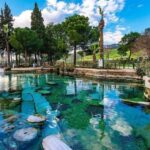
You’ll get another chunk of time for the Cleopatra Pools area. This is where people can walk and even swim in what’s described as a Roman bath complex—today associated with Cleopatra’s name.
The important practical note: entry to Cleopatra Pools is not included. So even if you feel like you already paid for the “Pamukkale thermal experience,” you’ll probably need to budget again here.
Is it worth it? For many people, yes, because it’s one more close-up way to experience the thermal water and the Roman-bath connection in the same place. But don’t treat it as a guaranteed included activity. Think of it as a paid add-on window that you should be ready for.
If your budget is tight, you can also use your time at the Natural Park terraces to get the main “white cliffs” effect. Cleopatra Pools becomes your bonus if you’re comfortable paying the extra entry.
Lunch and the Workshop Stop: Getting Fed Without Losing the Day
By the time the tour reaches the midday break, you’ll get an open buffet lunch at a local restaurant. In a long thermal-and-ruins day, this is a relief. You’re not hunting for food, and it’s timed so you don’t lose the rhythm of the plan.
Quality can be uneven on any tour-style buffet, but the aim is simple: feed you enough so you can keep walking. If you’re picky, bring a flexible mindset. This is not a Michelin-star hunt. It’s a logistics-friendly lunch built for a group schedule.
Later, there’s a stop at a local workshop where you can watch handcrafts being produced and take photos. You’ll also have a chance to buy souvenirs.
This part divides people. If you like demonstrations and you want a handmade keepsake, it can feel like a pleasant breather. If you’d rather put every minute into ruins and terraces, it can feel like a detour. Either way, it’s short enough that it usually won’t ruin the day—just manage expectations.
Guide Impact: When Ismail, Özlem, or Ahmet Makes It Click

The guide is a big deal on this kind of day tour, because you’re juggling ruins, thermal areas, and a bunch of sights in a limited timeframe. From what I’ve seen, the difference between a “nice tour” and a “this was great” day is often the guide’s energy and clarity.
On this route, guides you may be paired with include people like Ismail, Özlem, or Ahmet. When the guide is in top form, you’ll notice the storytelling: a quicker explanation of what you’re seeing in Hierapolis, a better sense of how the area functioned, and more confidence about where to look and why.
Even the phrasing matters. Some guides bring a very lively style, which helps you switch modes from soaking in warm water to focusing on stone-and-time history without zoning out.
What to Bring (So the Day Feels Easy, Not Miserable)
This tour is simple on paper, but Pamukkale is a place where small planning choices make a big difference.
Bring these:
- Money for entrance fees (they’re not included, and Cleopatra Pools is specifically extra)
- A plan for barefoot walking in thermal areas; painful steps are common if you rush
- Sun protection (hat, sunglasses, sunscreen). Even with a bus, there’s a lot of time outside
- A light cover-up for shifting between pools and ruins
If you’re traveling with kids: children may be asked for their valid passports at museum or site entrances to confirm age.
If you’re doing this in peak season, also expect a crowd factor on the white terraces. Going slow and choosing photo angles wisely beats sprinting for the best-looking spot.
Price and Value: Is $45 a Good Deal for Pamukkale?
At $45 per person, the headline value is that you’re paying for a full-day structure: hotel pickup/drop-off, air-conditioned transport, an English-speaking guide, and an open buffet lunch.
Here’s the fair part: Pamukkale doesn’t work like a “quick stop.” You lose time and energy if you’re trying to self-organize transport and tickets. The tour does that thinking for you.
The trick is that $45 is not the full cost of your Pamukkale day. Entrance fees are not included, and that can add up depending on what you want to do—especially if you’re set on Cleopatra Pools.
So my practical way to judge value is this:
- If you want guided context in Hierapolis and you want structured time across the thermal highlights, $45 often feels reasonable.
- If you only care about one or two areas and you’re fine getting around independently, you might decide the paid structure isn’t necessary.
Should You Book This Pamukkale Full-Day City Tour?
Book it if you want an organized, English-guided day that covers the key Pamukkale experiences in one go: Karahayit’s red spring soak, the Hierapolis ruins walk, time on the white terraces/Natural Park, and a chance at Cleopatra Pools.
Skip or reconsider if you hate paying extra at gates, or if you’re the type who wants long, quiet wandering with zero schedule pressure. The day is designed to move, and there’s limited time to go off-plan.
My best advice: treat it as a guided highlights day, not a budget all-inclusive. If you go in ready for entrance fees and you plan carefully for barefoot thermal walking, you’ll be more likely to come away happy instead of annoyed.
FAQ
What’s included in the Pamukkale City Tour price?
The tour includes hotel pickup and drop-off, an air-conditioned bus, open buffet lunch, and an English-speaking guide.
How long is the tour?
The duration is about 6 to 7 hours.
What time does the tour start?
Pickup starts around 9:30 am.
Where do I meet the tour if my hotel has privacy rules?
Meet at the main entrance gate of your hotel, not the reception.
What’s the main meeting point listed for this tour?
The meeting start point is Uyum Hotel, Pamukkale, Memet Akif Ersoy Blv. No:43, 20190 Pamukkale/Denizli, Türkiye.
Is the ticket for Hierapolis and Pamukkale included?
Entrance fees are not included. The stops covering Hierapolis/Pamukkale have admission ticket not included.
Is Cleopatra Pools included in the price?
No. The entrance fee to Cleopatra Pools is not included.
Is lunch included, and what type is it?
Yes. An open buffet lunch is included at a local restaurant.
Is there a limit on group size?
Yes. The maximum group size is 16 travelers.
What’s the cancellation policy?
You can cancel up to 24 hours in advance for a full refund. If you cancel less than 24 hours before the start time, the amount paid is not refunded.