REVIEW · ISTANBUL
Istanbul: Whirling Dervishes Ceremony and Mevlevi Sema
Book on GetYourGuide →Operated by Istanbul E-pass · Bookable on GetYourGuide
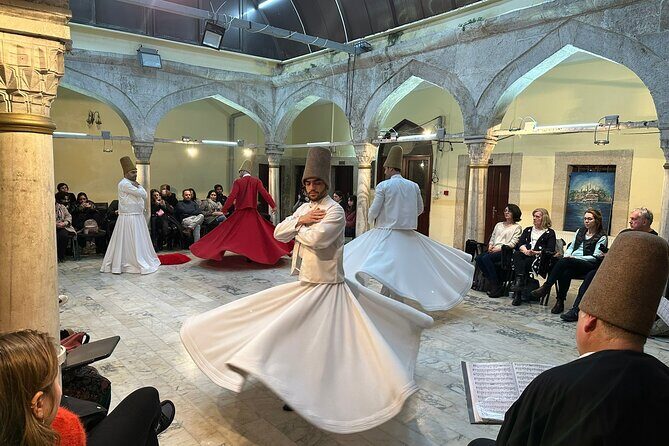
The whirling starts before you notice it. In the Hoca Rüstem Medrese, you’ll see the Mevlevi Sema ritual in a compact, historic setting, with live music building a focused mood. One consideration: it’s not a chatty show with lots of spoken explanation, so you’ll get more from it if you use the included audio guide and stay attentive.
You’re there for about an hour. There’s usually a calm wait with tea, then music and recitations come first before the dervishes begin the turning ritual. Plan to arrive early for the best sightlines, because the room can feel tight and some seats limit what you can see.
In This Review
- Key things to know before you go
- Mevlevi Sema at Hoca Rüstem Medrese: what you’re actually seeing
- Your 1-hour timeline: tea, music, then the turning
- Symbolism in the costumes and movements
- The live music and the hall sound: why silence helps
- Finding a good view in a small madrasa
- Audio guide app in English: how to use it without ruining the mood
- Respecting a religious Sema: simple rules that change the whole experience
- Price and value: is $23 a good deal in Istanbul?
- Who should book this, and who should think twice?
- Should you book this Whirling Dervishes ceremony?
- FAQ
- What is the price and duration of the Istanbul Whirling Dervishes ceremony?
- Where does the ceremony take place?
- What’s included with the ticket?
- What should I bring?
- Do I need to arrive early?
- Is there a host or greeter?
- How long is the music and when do the dervishes begin?
- What language is the audio guide in?
- Is hotel pickup included?
- Can I cancel or change plans?
- Is the venue wheelchair accessible?
Key things to know before you go
- 800-year-old tradition in a living Sufi practice tied to the Mevlevi order associated with Mevlana and Rumi
- Symbolic costumes and movements: black and white meanings, tall hats tied to the ego, and the whirling philosophy of harmony
- A simple 1-hour structure that moves from music and chanting into the whirling segment
- Live musical performance in a small hall, where silence and respect really matter
- Audio guide in English included, but you must bring headphones and a charged smartphone
- Seat matters in a small venue, so arrive ahead if you care about front-row views
Mevlevi Sema at Hoca Rüstem Medrese: what you’re actually seeing
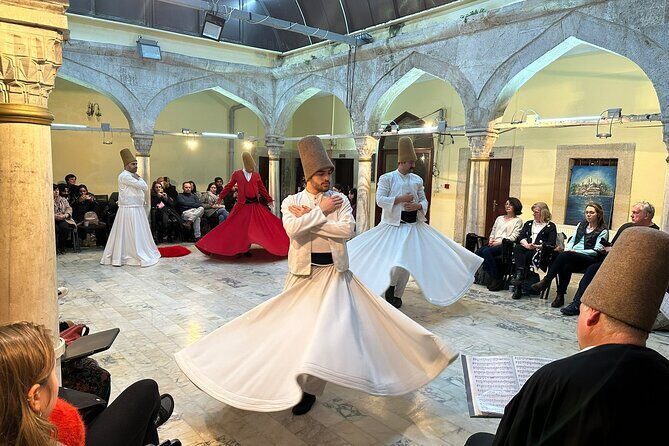
This isn’t a theme-park version of whirling. The point of the Mevlevi Sema is spiritual: a Sufi way of expressing the idea that the soul seeks harmony with creation. In the story of the order, the path is tied to the 12th-century figure who opened the way of pure love, and the order itself is associated with Mevlana Jelaleddini Rumi, whose name becomes the heart of the Mevlevi tradition.
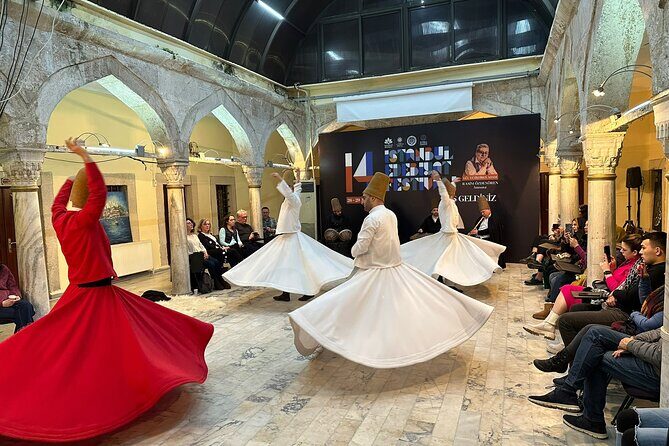
When the ceremony begins, watch for the discipline and the symbolism, not just the spinning. The “whirling” is described as being in harmony with the rest of creation. The tradition connects the act to cosmic pairs—day and night, summer and winter, life and death—and even imagery like the blood in veils. The ceremony also has a strong idea of transformation: the whirling is framed as the final act of acceptance into the order, after long training in monastery life, including kitchen work and daily duties.
One practical takeaway for you: this is easiest to enjoy if you treat it like a focused ritual. Your best role is quiet attention. If you’re hoping for a lecture, a running English script, or big crowd participation, you might feel like something is missing. But if you want music, movement, and meaning, this format works.
You can also read our reviews of more tours and experiences in Istanbul.



Your 1-hour timeline: tea, music, then the turning
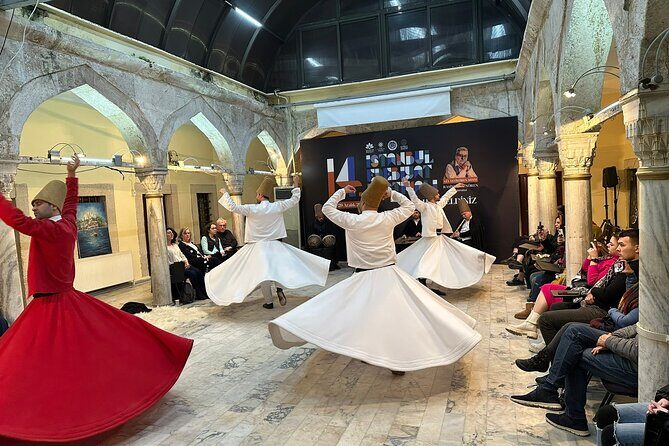
The event runs about an hour. The rhythm is usually pretty clear once you’re seated.
First, you’ll spend time with music—often with a trio of performers—plus singing/chanting and opening prayers. Think of this as the “setup” phase: sound fills the hall, and your brain starts matching that steady pace. Then the dervishes enter and the whirling ritual starts. Depending on the exact timing, the music segment can feel like the first 20 to 30 minutes, followed by roughly the second half being the turning.
Before all of that, you’ll typically wait in the hall area with tea. It’s one of those small comforts that helps you settle without feeling rushed.
Timing tip: the venue asks you to be at the hall about 15 minutes before the show starts. If you want the best view, don’t treat that as a suggestion. In a small space with limited front rows, arriving later can mean you’ll watch from an angle where the footwork is harder to see.
Symbolism in the costumes and movements
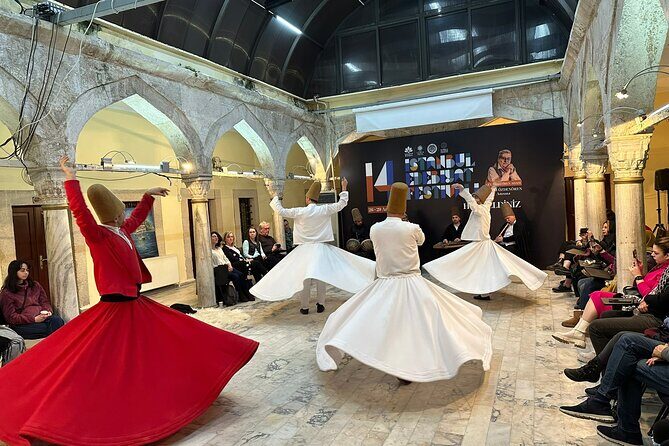
The Mevlevi Sema is packed with visual signals, and you can pick them up even if you don’t read Turkish. The ceremony explains the meaning through what the performers wear and how they move.
Start with the costumes. In the tradition’s explanation, color is not decoration. Black is associated with death, while white is tied to birth. The tall hats connect to tombstone imagery for the ego, and the way cloaks are worn or removed is meant to show shedding ego and moving toward spiritual alignment.
Next, watch the hands and posture. You may hear a description (and the audio guide can help here) that the right hand opens toward the sky as if receiving divine blessings, while the left hand points to the earth as if distributing blessings to humanity. Whether you fully interpret every gesture or not, you’ll feel the intentionality. The ceremony doesn’t ask you to guess randomly—it gives you cues.
Then there’s the whirling itself. The idea is harmony in motion: not frantic spinning, but a controlled practice tied to the belief that everything was created through that kind of turning energy. That’s why the performers look steady and composed. If you watch the faces and upper bodies, you’ll notice a calm focus that matches the sound.
One more thing: costumes and instruments are described as having specific meaning. That’s your hint to pay attention to transitions—when instruments start or stop, when garments are adjusted, and when the movement shifts from “approach” to “ritual.”
The live music and the hall sound: why silence helps
Live music is a major part of why this ceremony lands. You’re not just seeing movement; you’re hearing the structure behind it. The sound tends to come from a small ensemble: instruments plus singing/chanting, and the vibe of prayer recitations.
In many performances, the music feels like it’s steering your attention. The steady rhythm helps you stop thinking in “tour mode.” Instead, you start syncing with the ceremony’s pace. That’s why the room’s behavior matters. When people keep the noise down, the whole experience gets clearer.
A respectful note you should follow: treat the Sema as a religious ceremony, not a nightclub performance. The ceremony is meant to be observed quietly, and applause can feel out of place because it interrupts the ritual tone. If you’re not sure what to do, simply copy the calm behavior of the people around you and wait for the end.
If you want an extra layer of meaning, use the audio guide. With headphones, you can follow the ceremony’s ideas without needing spoken translation from the stage.
Finding a good view in a small madrasa
This venue is small. That’s part of the intimacy, and also part of the challenge.
You’ll likely see that the seating is limited, with only a couple of rows. A few people found that arriving later meant sitting behind a pillar, which blocks your line of sight. Others said the room can feel over packed, and that crowding can limit how much you see of the dancers’ footwork.
So here’s your game plan:
- Arrive earlier than the minimum if you care about front-row views.
- If you’re tall or want photos, consider where the hall pillars create sightline gaps.
- If you prefer seeing full-body movement rather than close details, you might prefer sitting a bit farther back.
Also note one practical photography consideration. Some found that lighting elements on the side panels can distract their eyes while shooting photos. You don’t have to avoid photos, but you might get better results by focusing your lens on the center action rather than the edges of the room.
Washrooms are available on site. Good to know if you’re planning your timing around an Istanbul evening.


Audio guide app in English: how to use it without ruining the mood
You get an audio guide app in English, and it’s meant to help you follow what you’re seeing. The catch is simple: bring headphones and make sure your smartphone is charged. The ceremony isn’t built around a live interpreter narrating everything moment by moment.
How I’d use the audio guide:
- Start before the dervishes come out, while the music sets the tone.
- Keep the volume comfortable. You want to hear the live ensemble too.
- Use it as a meaning guide rather than a full script. The ceremony is still best felt with your attention on movement and sound.
This is where the audio guide adds real value. Without it, the ritual can still feel powerful, but you may miss the “why” behind the colors, garments, and hand positions. With it, the ceremony becomes easier to interpret as a spiritual journey rather than just a dance.
Respecting a religious Sema: simple rules that change the whole experience
Even though you’re paying a ticket and watching seated in rows, this is not presented as a casual entertainment act. It’s a spiritual ritual carried out in the Sufi tradition of Islam, connected to the Mevlevi order.
So keep your behavior steady:
- Stay seated when you’re asked.
- Keep voices low while the ceremony is underway.
- Avoid clapping during the ritual portion. Wait until you’re clearly at the end.
One reason this matters: when the crowd respects the rhythm, the music and the turning feel more coherent. When people clap or talk loudly, you break the spell of the ceremony’s pacing.
Dress code isn’t specified in the info you provided, so don’t guess. Instead, follow venue staff cues and aim for comfortable, modest basics that let you sit still for about an hour.
Price and value: is $23 a good deal in Istanbul?
At $23 per person for a 1-hour experience, you’re not buying a long day tour. You’re buying access to a specific ritual in a historic setting, plus an English audio guide app. In practical terms, the value comes from three things:
1) You get live musicians and the dervishes’ ritual in the same session.
2) You get the “meaning layer” through audio guidance, not just a ticket and a seat.
3) The total time cost is low, which makes it easy to add to a busy Istanbul itinerary.
Where the value can drop for you is if you strongly prefer guided explanations in real time or if you’re sensitive to crowding and limited seating. Since the ceremony is short and the space is compact, the best value comes when you’re the type of visitor who can slow down for an hour and let the ritual unfold.
Also remember: there’s no hotel pickup or drop-off included. You’ll need to get yourself there. The good news is that the venue is in central Istanbul, so it’s typically doable as an add-on to other Sultanahmet/Fatih-area sightseeing plans.
Who should book this, and who should think twice?
This experience fits you best if:
- You like music, chanting, and disciplined performance.
- You want a spiritual, symbolic ritual rather than a museum-style lecture.
- You’re happy using the included audio guide to understand what you’re seeing.
- You enjoy quiet attention and don’t need constant explanations from staff.
You might consider a different kind of activity if:
- You want a long English narrative before each stage of the ceremony.
- You’re uncomfortable in tightly packed indoor spaces.
- You’re expecting a big theatrical spectacle with lots of audience interaction.
If you fall somewhere in the middle, you can still have a great time. Just come prepared to watch thoughtfully and use the audio guide to connect the visuals to the meaning.
Should you book this Whirling Dervishes ceremony?
If you’re curious about Mevlevi Sema and you can handle a quiet, short-format event, I think booking makes sense. The combination of live music, the disciplined whirling ritual, and the included English audio guide gives you enough structure to understand what you’re seeing without turning it into a loud, touristy production.
My decision rule is simple:
- Book it if you want an hour of music + ritual symbolism in a historic medrese.
- Skip or reconsider if you need heavy spoken interpretation or if you know you hate crowding in small venues.
Quick prep checklist: bring headphones, charge your phone, and arrive early for the best seating you can get.
FAQ
What is the price and duration of the Istanbul Whirling Dervishes ceremony?
The price is $23 per person and the experience lasts about 1 hour.
Where does the ceremony take place?
It takes place at the Hoca Rüstem Medrese in Istanbul.
What’s included with the ticket?
You get the ticket to the Whirling Dervishes ceremony and an audio guide app on your smartphone (English).
What should I bring?
Bring headphones and a charged smartphone.
Do I need to arrive early?
Yes. You need to be at the hall about 15 minutes before the show starts.
Is there a host or greeter?
Yes, there is an English-speaking host or greeter.
How long is the music and when do the dervishes begin?
The experience runs about 1 hour, and the ceremony includes a musical segment first, followed by the dervishes beginning their ritual.
What language is the audio guide in?
The audio guide is in English.
Is hotel pickup included?
No, hotel pickup and drop-off are not included.
Can I cancel or change plans?
You can cancel up to 24 hours in advance for a full refund, and there is also a reserve now & pay later option.
Is the venue wheelchair accessible?
Yes, the experience is wheelchair accessible.