REVIEW · ISTANBUL
Istanbul:Basilica Cistern Skip-the-Line Ticket & Audio Guide
Book on GetYourGuide →Operated by Istanbul Tourist Pass® · Bookable on GetYourGuide
Six hundred columns and one underground chill. The Basilica Cistern skip-the-line ticket helps you get in faster, and the English audio guide makes the underground space easier to read. I love the way the cistern turns into a maze of marble perspective, and I like having the big details ready before you reach the most famous spot.
One catch: you can’t escape all lines. You can’t skip security lines, and there could still be a line at the entrance, even with skip-the-ticket-line.
In This Review
- Key Takeaways Before You Go
- Skip-the-Ticket-Line, Then Read the Fine Print
- Getting Oriented: The Basilica Cistern’s Backstory
- The Big Scale Hits Fast: 140m, 70m, and 52 Steps Down
- Inside the Cistern: What the Columns Are Really Doing
- Medusa Heads: Roman Mystery, Greek Myth, and a Protective Twist
- Hagia Irene and the Surrounding Views You Might Miss
- Audio Guide Strategy: How to Get More Than “Headphones On”
- Value for Money: Is $54 Worth It?
- Who This Experience Fits Best
- Should You Book the Basilica Cistern Skip-the-Line + Audio Guide?
- FAQ
- What’s included with the Basilica Cistern ticket and audio guide?
- Do I get skip-the-line for security?
- Where is the Basilica Cistern located?
- How do I receive my ticket and audio guide?
- How long is the ticket valid?
- Is the audio guide available in English?
- Can I cancel for a refund?
- Is the free internet eSIM always included?
Key Takeaways Before You Go

- The audio guide is the real value boost: it gives you context for what you’re seeing, not just what it’s called.
- You’ll be surrounded by “number magic”: 52 steps down, 336 columns, 12 rows, and a huge underground footprint.
- Medusa heads are the highlight with real mystery: Roman-period pieces placed under columns, with unknown exact origins.
- It’s not just one monument: the experience also points you toward Hagia Irene and helps you connect the area to wider Istanbul views.
- Limited-time free eSIM internet can help you navigate without hunting for Wi-Fi.
Skip-the-Ticket-Line, Then Read the Fine Print

For $54 per person, this is all about saving time at the Basilica Cistern. The key detail is that the skip is for the ticket line only. You will still face mandatory security screening, and you might still see a line right at the entrance.
That matters because it changes how you should plan your day. If you’re pairing this with other sights nearby, keep some wiggle room. Also, once you’re inside, you’ll get a better payoff if you slow down. The cistern is designed to be looked at from multiple angles, not just photographed while rushing.
You’ll receive two things by email from Istanbul Tourist Pass: your entry ticket QR code(s) and your audio guide link. They arrive separately, so don’t wait until you’re already leaving for the day to check your inbox.
You can also read our reviews of more tours and experiences in Istanbul



Getting Oriented: The Basilica Cistern’s Backstory
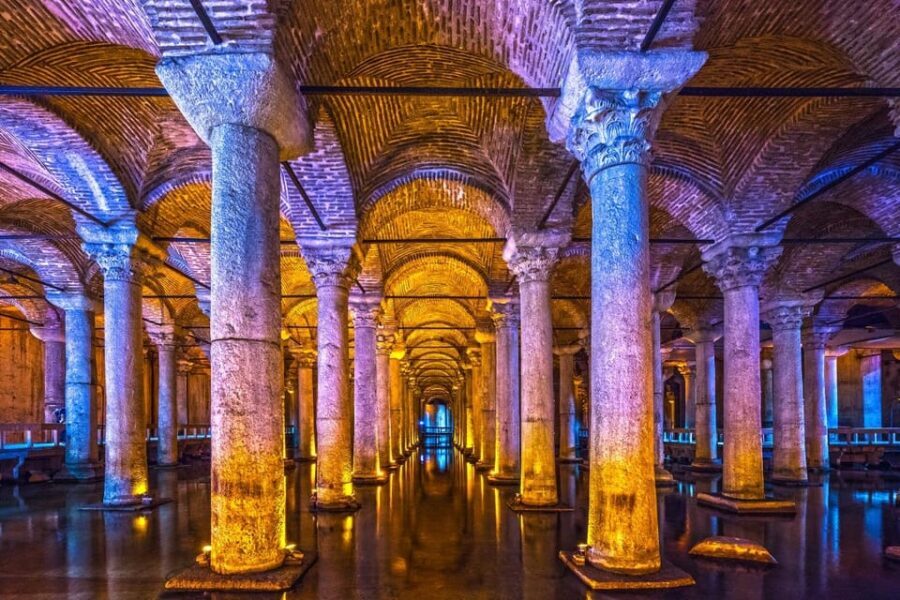
The Basilica Cistern sits southwest of Hagia Sophia, and it was built under Byzantine Emperor Justinianus I (527–565). Over time, it picked up two big nicknames. Locals call it Yerebatan Cistern, tied to the underground marble columns. The Basilica Cistern name comes from a basilica that once stood in the same spot.
When you descend the stairs, the building’s purpose becomes part of the experience. This is an ancient underground reservoir. You’re not just walking through a pretty ruin—you’re stepping into a structure built to store water at massive scale.
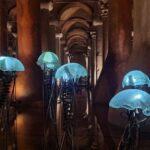
The design language is what gets me. The columns and arches don’t feel accidental. They create order underground, turning a utility space into something almost theatrical. And because you’re guided with an audio track, you can connect the visual to the logic.
The Big Scale Hits Fast: 140m, 70m, and 52 Steps Down
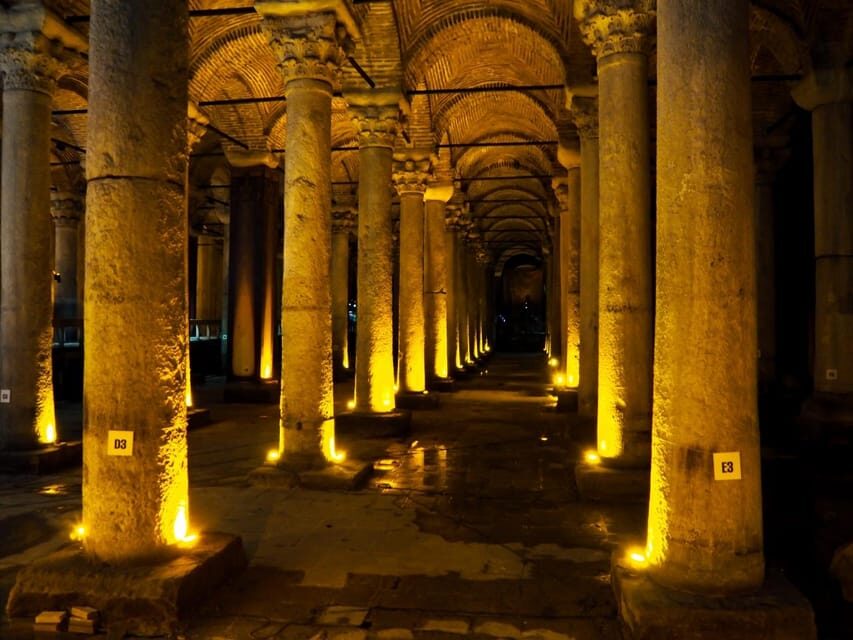
As soon as you enter, you’re hit with the cistern’s measurements. It stretches about 140 meters long and 70 meters wide, covering roughly 9,800 square meters.
To access it, you descend 52 steps. That step count is more than trivia. It’s the moment you transition from daylight street noise into a cooler, dimmer world where details start to matter more than speed.
Inside, you’ll see 336 columns, each about 9 meters tall. They’re arranged in 12 rows with 28 columns per row, spaced about 4.80 meters apart. The height and repetition are what make the cistern feel endless, almost like a forest where each trunk is a camera-ready line.
And if you like architecture, pay attention to the materials and styles. Many columns were reused from earlier structures, carved from different types of marble. Most are one piece, but some are made from two parts.
There’s also a style split: 98 columns are Corinthian style, while others are Dorian style. Without a guide, you’d probably just see columns. With the audio guide, you’re more likely to notice how those styles change the look of capitals and proportions.
Inside the Cistern: What the Columns Are Really Doing
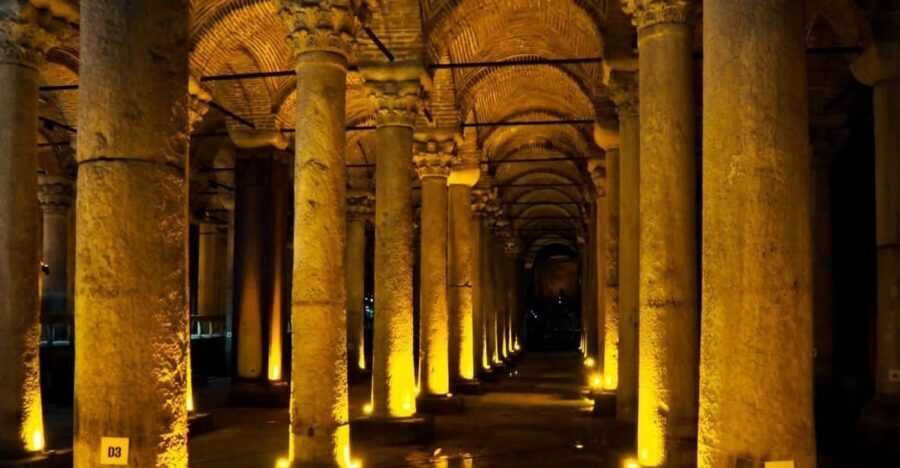
The cistern is laid out to support arches that create long visual corridors. Those arches and columns help distribute weight, but they also guide your eye. You naturally start moving in patterns, selecting which rows to follow and where to stop for the clearest sightlines.
Even the walls tell you what kind of engineering you’re in. Brick walls rise about 4.80 meters, and the floor uses bricks plus a thick layer of brick dust mortar meant to keep water tight. In other words: the cistern is practical, and the beauty is tied to the practicality.
I like that the audio guide approach encourages you to connect the human scale to the building scale. You’ll find yourself doing a mental math exercise on the size and capacity. The cistern’s storage capacity is estimated at about 100,000 tons of water.
That figure turns the experience from pretty to mind-bending. You’re standing in a place built to hold a huge volume, and every column is part of the system that made that possible.
Medusa Heads: Roman Mystery, Greek Myth, and a Protective Twist
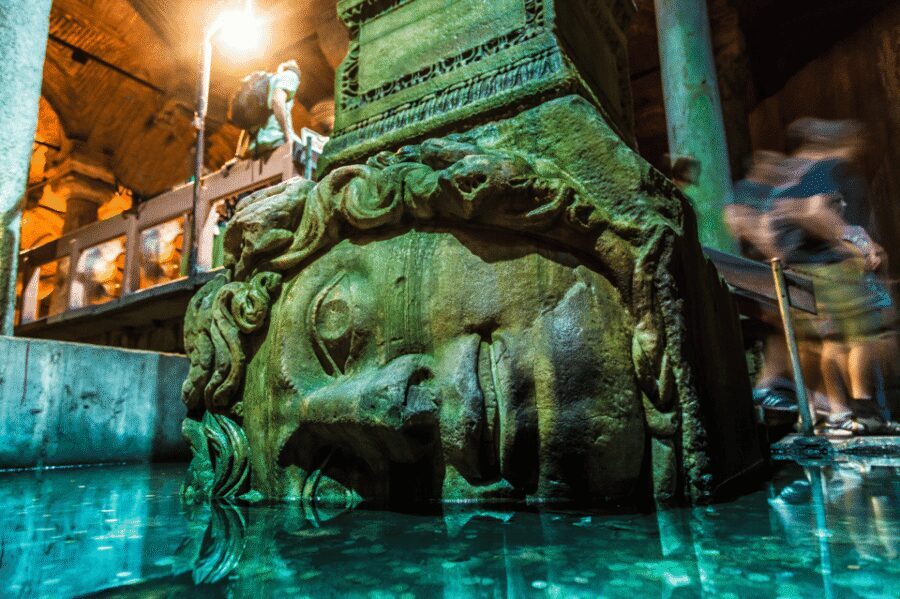
The most famous visual in the Basilica Cistern is the pair of Medusa heads. They’re used as supports under columns at the northwest edge of the cistern.
These heads date back to the Roman period, but their exact origin isn’t known. Researchers speculate they were brought here to support columns during construction. That uncertainty is part of the attraction. You’re not just looking at an art object—you’re looking at an artifact with a story that refuses to be fully solved.
Then the myth layer kicks in. In Greek mythology, Medusa was one of the three Gorgons, female monsters tied to the underground world. She had snake-like hair and the power to turn anyone who looked at her into stone. In ancient times, images of Gorgons were sometimes used as protective symbols.
The idea here is practical symbolism. Placing a Medusa head in the cistern was thought to protect important spaces. That makes the heads feel oddly functional—like a warning sign turned into architecture.
When you stand near them, look at them as both art and engineering. They’re supporting weight, but they also carry a cultural message. The audio guide format makes this easier because it helps you keep track of what you’re seeing and why it ended up here.
You can also read our reviews of more guided tours in Istanbul




Hagia Irene and the Surrounding Views You Might Miss
This experience includes more than just the underground reservoir. The highlights specifically point you toward Hagia Irene, described as the second biggest church of Istanbul. The audio component should help you connect the cistern area to nearby landmarks so you don’t treat it like a standalone detour.
The same highlight list also mentions breathtaking views over the Golden Horn and the Bosphorus. Even if you’re focused on the cistern’s interior, don’t plan to rush straight out. Build in a moment to step away from the cool dark interior and reorient yourself above ground.
That contrast is one of Istanbul’s best tricks. You go from engineered stone geometry under the city to the open drama of water and skyline. If you’re short on time, prioritize at least one viewpoint moment after the cistern. It’s the way to end the visit with your sense of place intact.
Audio Guide Strategy: How to Get More Than “Headphones On”
With a self-paced setup, your biggest risk is doing a quick lap. The cistern rewards patience. Use the audio guide to pace yourself—pause when something catches your eye, not when you’re walking past it.
Here’s what I’d do to get value fast:
- Start by listening as you enter, so you understand the cistern’s purpose and timeframe.
- As you approach the main forest of columns, switch to a slower walking pace and let the descriptions match what you see.
- When you reach the Medusa heads, focus on the two layers: the Roman artifact story and the Greek myth explanation.
The audio guide is in English, and it’s positioned as a professional guide, which usually means clearer structure than random phone clips. If you’re the type who likes details, you’ll enjoy how the guide translates measurements and styles into something you can actually notice.
Also, if the limited-time free internet eSIM offer is available when you book, it’s worth using. You’ll have help locating the next spot or pulling up extra context without hunting for Wi-Fi.
Value for Money: Is $54 Worth It?
At $54 per person, you’re paying for two things: the skip-the-ticket-line access to the Basilica Cistern and the English audio guide, plus the chance of limited-time internet through an eSIM.
Here’s how I judge value for a site like this. If you’re going at a peak time, skip-the-ticket-line can be a real quality-of-day upgrade. Waiting outside with other people is time you can’t get back. The skip helps you shift that time into actually looking at what you came for.
The audio guide is the second value pillar. Basilica Cistern is famous, but it’s also easy to see it as “columns in the dark.” The audio guide helps you notice style differences, understand the reservoir design, and interpret the Medusa heads beyond “cool photo spot.”
The only reason the price might feel steep is if you prefer to wander without commentary and you’re visiting at a time when lines aren’t an issue. But even then, the cistern’s scale and the Medusa mystery make it a strong stop.
Who This Experience Fits Best
I think this works especially well if:
- You want to see the Basilica Cistern but hate wasting time in long ticket lines.
- You like architecture and want the measurements and design choices explained.
- You prefer self-paced exploring with an audio guide in a language you can comfortably follow.
- You’re planning a day of historic sights around Hagia Sophia and nearby landmarks.
It’s less ideal if you strongly dislike audio guides and only want silent, casual wandering. It also isn’t a “no lines at all” ticket, since security screening still happens.
Should You Book the Basilica Cistern Skip-the-Line + Audio Guide?
If you want a smooth entrance and you like understanding what you’re looking at, I’d book it. The combination of skip-the-ticket-line plus a structured English audio guide is a practical way to get the most from a place built on details.
Pick this option if you’ll appreciate the specifics: Justinian-era origins, 52 steps down, the 336-column geometry, the style mix of Corinthian and Dorian columns, and the Medusa heads at the northwest edge. Those are the exact details that turn a famous sight into a memorable one.
FAQ
What’s included with the Basilica Cistern ticket and audio guide?
You get a Basilica Cistern skip-the-ticket-line entry ticket (the skip is tied to the Basilica Cistern), plus an English professional audio guide link. The experience may also include free internet via an eSIM for limited time only.
Do I get skip-the-line for security?
No. The info says you cannot skip security lines, and security screening is mandatory for all visitors.
Where is the Basilica Cistern located?
It’s located southwest of Hagia Sophia in Istanbul.
How do I receive my ticket and audio guide?
You receive both entry ticket QR code(s) and the audio guide link via separate emails from the supplier Istanbul Tourist Pass.
How long is the ticket valid?
The ticket is valid for 1 day. Check availability to see starting times.
Is the audio guide available in English?
Yes, the audio guide included is in English.
Can I cancel for a refund?
Yes. Free cancellation is available up to 24 hours in advance for a full refund.
Is the free internet eSIM always included?
It’s listed as free internet with an eSIM for limited time only, so it depends on availability at booking.