REVIEW · ISTANBUL
Afternoon Bosphorus Cruise Luxury Yacht with Professional Guide
Book on Viator →Operated by Yacht Cruises: Bosphorus · Bookable on Viator
Istanbul looks different from the water. On this afternoon Bosphorus luxury yacht cruise, you glide between the continents as you learn what you’re actually seeing: fortresses, sultans’ palaces, and the iconic skyline pieces that make Istanbul so hard to forget.
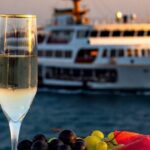
I really like two things here. First, the professional guide helps the views snap into place fast, from the Bosphorus currents to why Dolmabahçe and Çırağan matter. Second, the onboard touches feel like actual hospitality, not a token snack—fresh lemonade with mint, water, tea and coffee, plus a fruit plate and treats like baklava and cookies served during the ride. One drawback: this is time on the water, so it’s not recommended if you have vertigo or get seasick, and the cruise depends on good weather.
In This Review
- Quick Highlights You’ll Feel Immediately
- Bosphorus Views in About Two Hours, Without the Hassle
- Price and Inclusions: Why This One Feels Like Value
- Where You Meet in Beyoğlu and What to Expect Onboard
- The Bosphorus Strait: Asia Meets Europe on a Moving Highway
- Dolmabahçe Palace and Çırağan Palace: Sultans’ Waterfront Drama
- Dolmabahçe Palace, by the waterline
- Çırağan Palace: marble, imprisonment, and a second life
- Ortaköy, the Bosphorus Bridge, and the Views You’ll Want for Photos
- Rumeli Hisarı and Anadolu Hisarı: Fortresses Built at the Narrowest Point
- Rumeli Hisarı (Rumeli Fortress)
- Anadolu Hisarı (Anatolian Fortress)
- Küçüksu Pavilion, Beylerbeyi Palace, and the Bosphorus Under the Bridge
- Küçüksu Pavilion
- Beylerbeyi Palace right under the bridge
- Kız Kulesi (Maiden’s Tower): The Legend You’ll Actually Understand
- Galata Bridge and Galata Tower: Ending With Golden Horn Energy
- Galata Bridge’s daily-life drama
- Galata Tower’s “from jail to panoramic view” story
- Who This Cruise Suits Best (and Who Might Skip It)
- Should You Book the Afternoon Bosphorus Luxury Yacht Cruise?
- FAQ
- How long is the Bosphorus luxury yacht cruise?
- What’s included in the ticket price?
- Are alcoholic beverages included?
- What language is the guide?
- Do I need to bring a paper ticket?
- Is this tour suitable for seasickness or vertigo?
Quick Highlights You’ll Feel Immediately
- Luxury yacht comfort for a short window: about two hours, small group size up to 30
- Real onboard refreshment: homemade lemonade with fresh mint, tea/coffee, plus a fruit plate and cookies/baklava
- An English guide who connects landmarks to the big picture: the Bosphorus as Asia–Europe gateway, not just scenery
- Signature photo moments: Bosphorus Bridge, Beylerbeyi Palace under the bridge, and Kız Kulesi (Maiden’s Tower)
- Big-name waterfront stops in one loop: Dolmabahçe, Çırağan, Ortaköy, Rumeli Hisarı and Anadolu Hisarı
Bosphorus Views in About Two Hours, Without the Hassle
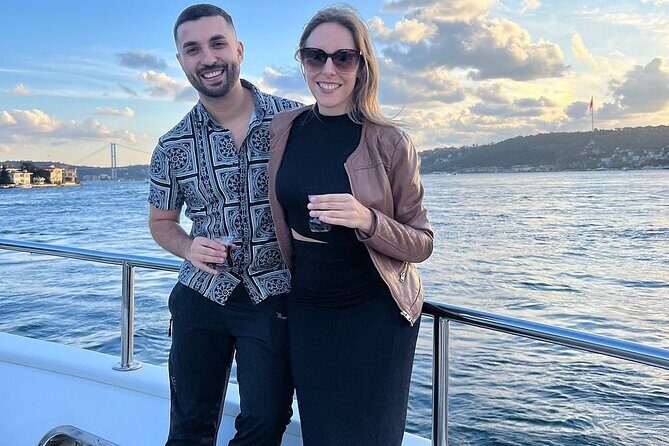
This is one of those Istanbul experiences where the timing is the whole point. In about 2 hours, you get the dramatic Bosphorus panorama—without committing an entire day to transit and multiple ticket lines.
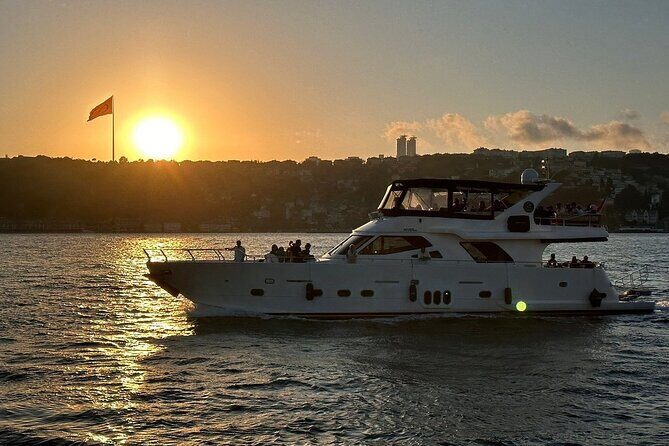
You’ll also be on a luxury yacht, which changes the feel right away. Instead of squeezing into a busy waterfront spot, you’re sitting back while the shoreline moves past at your pace. And with a guide onboard, you’re not stuck guessing what’s what among the palaces and fortresses.
Practical note: this is best as a “see the big stuff” cruise. If you’re looking for deep museum time inside buildings, plan separate stops on shore. Here, the value is the water-level perspective and the story that comes with it.
You can also read our reviews of more boat tours in Istanbul

Price and Inclusions: Why This One Feels Like Value
At $25.74 per person, this cruise is priced like a smart add-on, not a once-in-a-lifetime splurge. The reason it feels like value is what’s included for that money.
You get:
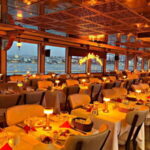
- 2 hours on a luxury yacht
- Restroom on board
- Complimentary drinks: homemade lemonade with fresh mint, water, tea, and coffee
- Food onboard: a daily prepared fresh season fruits plate, plus cookies and baklava
- Professional guide and English commentary
Alcoholic drinks are not included, so if you want cocktails, you’ll need to budget separately. But for most people, the included lemonade + sweets combo is exactly the comfort you want in the afternoon.
What I like most about this setup is that it keeps your day flexible. You’re not spending the whole afternoon hunting for snacks or plotting where to stop next. You’re already on a guided, scenic route with the basics handled.
Where You Meet in Beyoğlu and What to Expect Onboard

You start at Türkiye Petrolleri Ömer Avni, Meclis-i Mebusan Cd. No:34, 34427 Beyoğlu/İstanbul. It’s in Beyoğlu, and it’s listed as near public transportation, which matters in a city where traffic and walking can both be unpredictable.
The tour runs with a start time of 1:00 pm, and the company uses a mobile ticket, so you can keep things simple right up to boarding.
Onboard, expect:
- A group capped at 30 travelers
- An English-speaking guide
- A restroom available (small detail, big quality-of-life upgrade on a short tour)
- A laid-back rhythm, because the whole point is to watch the Bosphorus and absorb what the guide explains
If you’re sensitive to motion, take the “not recommended for vertigo and seasickness” note seriously. Two hours is short, but it’s still time on open water.
The Bosphorus Strait: Asia Meets Europe on a Moving Highway
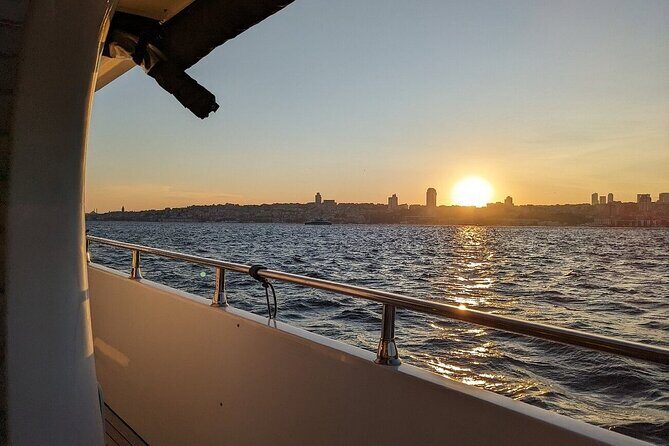
The main event is the Bosphorus itself. This strait separates Europe and Asia and connects the Sea of Marmara to the Black Sea. You’ll pass through a corridor that’s only about 30 kilometers long, but it has the kind of scale that changes how Istanbul looks.
Here are the facts that tend to make the cruising experience click:
- The Bosphorus runs roughly northeast to southwest, dividing Istanbul into the European and Anatolian sides.
- Depth averages around 60 meters, with deeper points up to about 120 meters.
- The water isn’t the same everywhere—its width varies a lot depending on where you are, with the broadest stretch noted around 3,500 meters.
- There are strong currents: surface flow tends to move from the Black Sea toward Marmara, while underwater flow runs the opposite way.
With a guide talking you through those basics, you stop seeing it as just a pretty strait. You start seeing it as an actual water system. That’s when you’ll understand why Istanbul’s waterfront cities are so built up and so strategically placed.
Dolmabahçe Palace and Çırağan Palace: Sultans’ Waterfront Drama
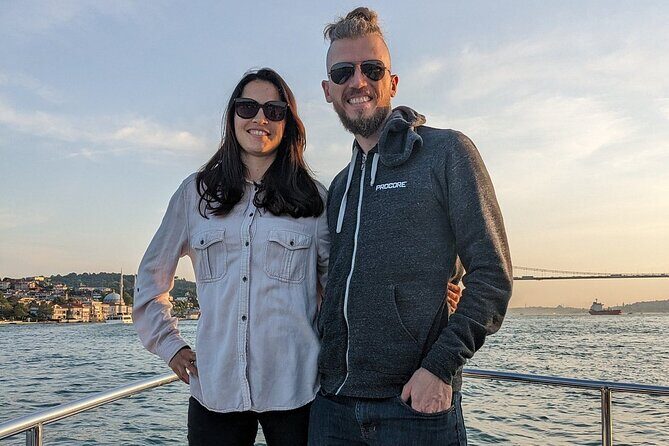
As you glide along the European shoreline, you’ll come up to two major palace names: Dolmabahçe Palace and Çırağan Palace. From the water, these sites read as what they were meant to be: statements of power tied directly to the Bosphorus.
You can also read our reviews of more guided tours in Istanbul


Dolmabahçe Palace, by the waterline
Dolmabahçe sits on a large estate—about 250,000 m²—in Beşiktaş, between the Dolmabahçe Street area and the Bosphorus. The setting is part of the story: it’s on the left bank at the entrance from the Sea of Marmara, opposite Üsküdar and Kuzguncuk.
Even if you’re only seeing the exterior from the yacht, the placement helps you grasp the “cove turned palace” idea. This area used to anchor ships in earlier times, and later became a favorite residence of the sultanate.
Çırağan Palace: marble, imprisonment, and a second life
Çırağan Palace was commissioned by Sultan Abdulaziz and designed by Sarkis Balyan. Construction finished in 1871, and the palace is described as marble with a total area around 80,000 square meters.
The most compelling part is what happened after political shifts:
- After Abdulaziz was deposed, he was imprisoned there with his family.
- After Murat V was deposed, he also was imprisoned there for 29 years, again with family.
- In 1908, after the Second Constitutional Monarchy, it was used as the House of Parliament.
- It was damaged by fire in 1910.
- Later, the grounds were transferred to Beşiktaş Sports Club, used as the Seref Stadium for a time.
- The early 1990s restoration reopened it as a luxury hotel.
From a yacht, you won’t tour interior rooms. But you will understand the palace as a machine that kept showing up in major chapters of Ottoman and early modern Turkey.
Ortaköy, the Bosphorus Bridge, and the Views You’ll Want for Photos
Next comes the feel of Ortaköy on the European side (near Beşiktaş). Ortaköy is a coastal neighborhood on slopes opening to the water, and it includes Ortaköy and Mecidiye districts.
The guide-style value here is context. Ortaköy’s bazaar area is described as lively at all hours, with the market and shops feeding into cafes and restaurants. There’s also a timing detail worth knowing: the market starts to feel more active after 10:00 am. On an afternoon cruise, you’ll already be past that morning ramp-up, which is good to keep in mind if you’re pairing this with an extra stroll later.
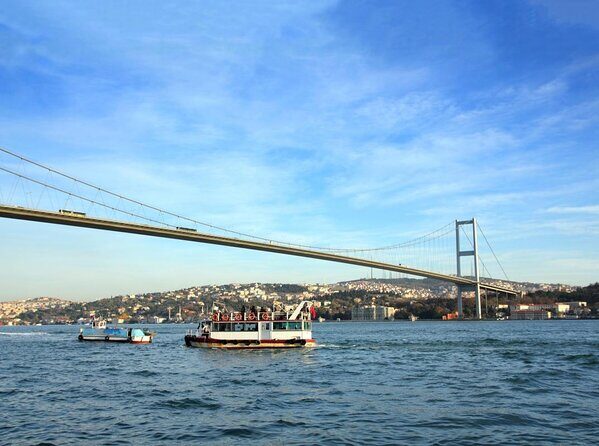
Then you’ll see one of Istanbul’s engineering icons: the Bosphorus Bridge. The feet of the bridge are located in Ortaköy (European side) and Beylerbeyi (Anatolian side). It’s the first bridge built across the Bosphorus, opened on 29 October 1973, on the 50th anniversary of the Republic.
It’s also tied to everyday movement and events—shown as very active at all hours, and noted as an important crossing point for the Istanbul Eurasia Marathon.
If you want one practical photo tip: aim your camera for wide shots that include both shoreline directions. The bridge gives you a perfect anchor for that “I’m between two continents” perspective.
Rumeli Hisarı and Anadolu Hisarı: Fortresses Built at the Narrowest Point
The cruise route brings you toward the Bosphorus chokepoints where defense made sense.
Rumeli Hisarı (Rumeli Fortress)
Rumeli Hisarı is in Sarıyer, constructed directly across from Anadolu Hisarı. Construction began in 1453 on order of Sultan Mehmet the Conqueror, placed at the narrowest point of the Bosphorus. The remarkable detail here is speed: completion took only three months.
Before the conquest, the fortress protected against naval attacks. After conquest, it became an inspection point for maritime traffic. Later restoration removed small wooden houses, and today it’s known for summer concerts and serves as an open-air theater and museum.
From the yacht, you’ll mainly get how it sits into the waterway. That context helps you imagine the logistics of sailing and inspection during Ottoman times.
Anadolu Hisarı (Anatolian Fortress)
Across the way on the Asian side is Anadolu Hisarı, located in Beykoz at the narrowest point. It was built in 1395 by Beyazıt I and includes a citadel and exterior castle walls.
After the conquest of Istanbul, its strategic importance faded, and it became a military hospital. Over time the surrounding area settled, with waterfront houses and mansions scattered around the ruins. Restoration ran from 1991 to 1993, and it was converted into a museum—though it’s noted as not open to the public. Today, you can visit the outer walls, but the road passes just through the area.
Again, on a yacht, you’ll appreciate Anadolu Hisarı mostly through the exterior view and the way it frames the narrow-water story of the Bosphorus.
Küçüksu Pavilion, Beylerbeyi Palace, and the Bosphorus Under the Bridge
A cruise here keeps layering in the Bosphorus as a corridor of leisure for Ottoman rulers—not only defense and politics.
Küçüksu Pavilion
You’ll see Küçüksu Pavilion museum, used by multiple Ottoman emperors as a summer palace and hunting lodge. Even a brief view from the water can make the concept feel real: the Bosphorus wasn’t only for war planning. It was also for seasonal life and sport.
Beylerbeyi Palace right under the bridge
Then comes Beylerbeyi Palace, meaning Lord of Lords, built in the 1860s on the shores of the Bosphorus. It lies right under the Bosphorus Bridge, and it was designed by Sarkis Balyan.
The architecture is described as mixing elements from Renaissance and Baroque, plus styles from both East and West. From the boat, you’ll notice the complexity more than you can read it—still, the guide can translate what the mixed styles were trying to communicate.
The palace complex includes:
- A main two-store structure (stone on a high basement) on a land area around 2,500 m²
- 6 halls and 24 rooms
- A hamam and bathroom in the two-store layout
- A garden and a lily pond, plus fantastic Bosphorus views
If you’re the type who likes gardens but hates long museum rules, this is a good compromise. You’re getting the outdoor atmosphere from the water perspective.
Kız Kulesi (Maiden’s Tower): The Legend You’ll Actually Understand
One of the most recognizable skyline features is Kız Kulesi, the Maiden’s Tower. It’s built on a tiny island about 200 meters from the shore of Üsküdar.
The story is the classic legend: an oracle predicts that a sultan’s daughter will die on her 18th birthday from a snake bite. The sultan tries to protect her by building a tower in the middle of the Bosphorus, where she lives in secrecy. On her birthday, she receives a basket of fruits, reaches inside, and the snake bites—ending the story as foretold.
Even if the legend isn’t your thing, the tower’s placement is. From the cruise, you’ll see how the Bosphorus makes a small island feel dramatic and isolated.
Galata Bridge and Galata Tower: Ending With Golden Horn Energy
The route also includes two of Istanbul’s most famous Golden Horn landmarks: the Galata Bridge and Galata Tower.
Galata Bridge’s daily-life drama
The bridge’s history begins in 1845 and it connects the two sides of the Golden Horn. It’s changed over the years, including a big moment in 1992 when it was damaged by fire. A new bridge replaced it, and the older one was moved to Haliç.
Why it matters from the water: Galata Bridge is described as a daily hub with restaurants and cafes underneath, plus hookah lounges. Above it, you get the tramway and pedestrian traffic.
If you cruise near it in daylight, you’ll likely find it easier to imagine the scene than if you just stop for a photo from the street. You can see how movement, food, and views all stack up.
Galata Tower’s “from jail to panoramic view” story
Built by Genoese in 1348, the nine-story Galata Tower reaches 66.90 meters and was the tallest building in the city when it was built. In the Ottoman era it served different purposes, including a fire observatory and a jail.
One striking moment: in 1632, Hezarfen Ahmet Çelebi reportedly glided from the top of the tower across the Bosphorus to Üsküdar with self-constructed wings. Later, during a storm in 1875, the conic roof was destroyed and not restored during the Ottoman era. In the 1960s, the cap was restored, and the wooden interior was replaced with concrete. Today, the tower is open to the public, with a restaurant and café on its upper floor.
From your yacht seat, you’ll get the skyline impact immediately. If you later want a full view, the tower makes sense as a follow-up.
Who This Cruise Suits Best (and Who Might Skip It)
This afternoon Bosphorus yacht is a great fit if:
- You want big Istanbul sights in a short time
- You prefer staying on the water for comfort rather than hopping between distant locations
- You like a guide who explains what you’re seeing in English
- You enjoy simple onboard food: fruit, cookies, and baklava, plus lemonade and tea/coffee
You might want to skip or rethink it if:
- You get seasick or have vertigo risks
- You’re looking for long shore walks or museum time inside palaces and forts
Also, because the cruise is weather-dependent, if you’re traveling in a week with unstable conditions, keep your schedule flexible.
Should You Book the Afternoon Bosphorus Luxury Yacht Cruise?
If you want a high-return afternoon in Istanbul, I think this one is an easy yes. It’s short, comfortable, and built around the Bosphorus viewpoints that can take days to piece together on land. The guide support plus onboard drinks and sweets make it feel complete, not like a rushed sightseeing shuffle.
One more nudge: pay attention to how you’ll handle water motion. If you’re fine on boats, this is a smart way to connect Istanbul’s Asia–Europe story to real landmarks like Dolmabahçe, Çırağan, Beylerbeyi, Kız Kulesi, and the Galata skyline.
FAQ
How long is the Bosphorus luxury yacht cruise?
It’s listed as approximately 2 hours.
What’s included in the ticket price?
You get the 2-hour luxury yacht cruise, restroom on board, complimentary drinks (homemade lemonade with fresh mint, water, tea, and coffee), and a fresh season fruits plate plus cookies and baklava served aboard.
Are alcoholic beverages included?
No. Alcoholic beverages are not included.
What language is the guide?
The experience is offered in English.
Do I need to bring a paper ticket?
No. It’s a mobile ticket.
Is this tour suitable for seasickness or vertigo?
It’s not recommended for vertigo and seasickness. The cruise also requires good weather. If it’s canceled due to poor weather, you’ll be offered a different date or a full refund.